- Home
- Knots and Crimping
- Uni-Knot
How to Tie the Strong and Versatile Uni-Knot
If you decided to learn how to tie just one saltwater fishing knot - make sure it's the Uni-Knot!
As one of the easiest fishing knots to tie, and with a breaking strength only slightly less than the line it's tied in, you can use it to attach the line to your swivels, hooks, lures (although the Rapala Knot is a better knot to use for lures) along with any other rigging hardware, and also to join two lines together.
As such, many sea anglers tie two uni-knots in tandem for connecting their mainline to their leader as shown further down this page.
It's ideal for use with mono and fluorocarbon lines, and although it can be used with braid line, the braid knot would be a better choice.
Here's how to tie it ...
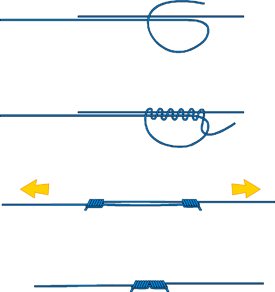
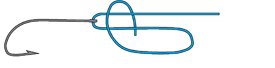 Stage 1 |
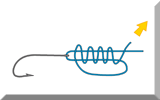
First, pass a line through the eye of the hook and form a loop as shown here. |
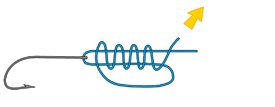 Stage 2 |
Now make at least four turns (more for light lines) around both strands and through the loop. Wet the knot with saliva and start tightening it by first pulling on the tag end in the direction of the arrow |
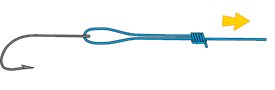 Stage 3 |
Then, with the knot now well consolidated, snip the end off close and pull on the line to slide it down towards the hook. |
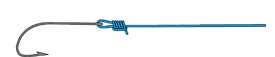 Stage 4 |
And that's it, the finished knot, as it's tied for attaching the line to swivels, hooks and lures. |
Artwork by Andrew Simpson
The following tandem version is a simple way of joining two lines of similar diameters. Each line ties a Uni Knot around the other before the two knots are pulled together to complete the connection.
In this form it's often called, for obvious reasons, the Leader Knot.
Recent Articles


-
Sea Fishing Rods and Reels Must Be Compatible for a Balanced Outfit
Mar 08, 21 08:30 AM
A quality reel fitted to a quality rod doesn't necessarily make it a quality outfit. Your fishing rods and reels have to be properly matched if you're to get the best out of them, and here’s how -
Essential Lure Fishing Tips That All Saltwater Anglers Should Know
Mar 08, 21 04:51 AM
Which single lure fishing tip applies to trolling, jigging, baitcasting, spinning, fly fishing and any other branch of lure fishing? Well, it is the one at the top of this list -
Vital Jig Fishing Tips That You Really Cannot Afford To Miss!
Mar 07, 21 10:20 AM
Essential jig fishing tips to help you select the right lure for successful jig fishing, together with the techniques required to get the most out of your jig fishing outfit

FTC Disclosure: In some of the articles on this site, I endorse some items of fishing gear. If you buy something through a link, I receive a small commission with no additional cost to you. Thank you for supporting this site. It is much appreciated.

New! Comments
Have your say about what you've just read! Leave me a comment in the box below.