- Home
- All About Rods
All About Saltwater
Fishing Rods
Modern saltwater fishing rods have a certain amount of information marked on them just above the handle.
Rod length will be one (in metres or feet), casting weight (in ounces or grams) - if it's a spinning or surfcasting rod - another, and line class rating (in pounds or kilograms) if it's a boat rod.
Saltwater fishing rods intended for casting techniques will also be marked with 'F/S' or 'M'.
'F/S' stands for 'Fixed Spool' reel, which is the name we Brits give to spinning reels, and 'M' stands for 'Multiplier' reel which our pals on the other side of the Atlantic Ocean call baitcast reels, or traditional reels.
As these rods have been optimised for use with one or other of these reel types, it's important to stick with the reel type for which the rod has been designed.
Rods for Multiplier Reels
On this page...
Boat Rods:~
Shore Rods:~
A saltwater fishing rod marked with 'M' will have been designed specifically for use with a multiplier (or baitcaster) reel.
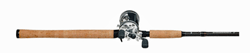
As this type of reel is used on top of the rod, then the line guides will be small and closely spaced to keep the line clear of the blank when the rod takes up its maximum power curve.
Rods for Fixed Spool Reels
A saltwater fishing rod marked with 'F/S' or 'S' will have been designed specifically for use with a Fixed Spool reel (or Spinning reel), which is fixed below the rod.
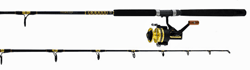
Now there'll be fewer guides required, but those closest to the reel will be of a larger diameter to accommodate the coils of line that come off the fixed spool during casting.
So if you're thinking of getting your hands on a new saltwater fishing rod, make sure it's designed for the reel type you'll be using with it.
OK, it is possible to use a fixed spool reel on a saltwater fishing rod intended for a multiplier, providing you're happy with shorter casts than you'd otherwise achieve - but not the other way round, as if you use a multiplier reel on a rod intended for a fixed spool reel, the line will rub against the blank, damaging both rod and line.
You do need to get this right!
Unsure of Rod Data like Test Curves, Casting Weights, Line Class Ratings, Rod Action and other stuff?
Here's all the data about Saltwater Fishing Rods!
1. Boat Rods
Designers of saltwater fishing rods are fully aware of the qualities demanded by expert anglers for their chosen specialisation, and manufacturers aren't slow to capitalise on the commercial opportunity created by our demands.
Hence, we have a huge range of high quality boat rods to choose from - for uptiding, downtiding, trolling or jigging - each of which will have been built up from a blank with specific power characteristics for a defined application.
They'll be marked as being suitable for use within either:~
- A range of casting weights, for example 4oz-6oz, 6oz-8oz, and 8oz-10oz
- Line class ratings such as 12lb, 20lb, 30lb, 50lb or 80lb.
The line class rods are often constructed with a slotted butt-end fitting for use with a butt pad, or fighting chair, and should be supplied with a rubber pad to cover it when you're using it with neither.
1a. General Purpose Boat Rods
As their name suggests, these saltwater fishing rods are designed to cater for most boat fishing applications, but by their very nature must be something of a compromise.
General purpose boat rods are normally between 6ft and 8ft long and will be fitted with ring-type line guides, enabling them to be used with either a multiplier reel, a fixed spool reel, or an Alvey type drum reel.
Typically, they will have a line class rating of between 20lb and 50lb.
Unless you want to specialise in uptide ledgering (which will require a longer rod optimised for casting), and want to stick with just one boat rod, a saltwater fishing rod of this type may well suit your requirements reasonably adequately.
But of course no single rod is ever going to be suitable for all types of boat fishing...
1b. Boat Rods for use with Braid Line
The are several good reasons for using braid line, but unless the rod is properly matched to it most of the associated benefits will be cancelled out. And it's braids non-stretch characteristic which is the problem.
Whilst this will greatly reduce the effect of the tide, allow the use of lighter sinkers and provide much better bite indication, the absence of 'give' in the system may tear the hook from the fish's mouth and test all knotted connections to the point of failure.
Click Here for more on Braid Line Boat Rods....
1c. Multi-Tip Saltwater Fishing Rods
Another effect that braid is having on saltwater fishing rod design is the development of exchangeable glass-fibre tips, known as quiver tips.
These tips, originally developed by match (tournament) anglers, are of different stiffnesses to suit heavy/light weights, casting range and sea conditions whilst maximizing bite detection.
1d. Downtide Saltwater Fishing Rods
Downtide rods are specifically designed for fishing downtide from an anchored boat, for a range of fish species, conditions and techniques.
Between 6ft and 8ft long to be manageable on both crowded charter boats and small dinghies, downtide rods are generally designed to be used with multiplier reels.
As a result, many have a rod tip roller guide, some have a double roller guide closest to the reel, and others have roller guides throughout.
Downtide rods are produced in several line class ranges - 5lb to 10lb, 10lb to 15lb, 15lb to 20lb, 20lb to 30lb, 30lb to 50lb, and 50lb to 80lb.
Every size in fact to suit sheltered estuary flattie bashing, dropping a fish-bait back into a wreck from an anchored boat through to battling with the largest shark offshore, for example:~
Very Light ~ 5lb to 10lb
- Shallow sheltered estuary ;
- Fishing with a baited spoon for flatfish;
- Reef fishing for black bream in calm conditions;
- Free-lining a live sand eel for bass
Light ~ 10lb to 15lb
- Jigging for baitfish and mackerel with a string of hokkais or similar small lures;
- Fishing with a live sand eel for bass and pollack;
- Light wreck fishing
Medium Light ~ 15lb to 20lb
- General, inshore dinghy fishing;
- Light wreck fishing with shads and jellyworms;
- Fishing a paternoster rig at slack water
Medium ~ 20lb to 30lb
- General, charter boat fishing;
- Wreck fishing with braid line;
- Ledgering with worm and fish baits;
- Tope fishing
Medium Heavy ~ 30lb to 50lb
- Heavy wreck fishing with large pirks and strings of muppets;
- Deep water jigging;
- Bottom fishing with fish baits for conger and ling;
- Blue shark fishing
Heavy ~ 50lb to 80lb
- Wreck fishing for the largest conger eels;
- Shark fishing, for large mako and porbeagle
1f. Uptide Rods
Uptide rods, being much like a mini version of a beachcaster, are designed for casting lead weights within ranges between 4oz and 10oz, ie 4oz to 5oz, 5oz to 6oz, 6oz to 8oz, and 8oz to 10oz. Spiked, or breakaway leads are used to hold the lead in position on the seabed where it lands.
With the line held across the tide, the water pressure on it will be high, so the thinner the line, the least affect the tide will have. Consequently, in strong tides, heavy leads and thin braid lines work best.
Click Here for more on Uptide Rods ....
1g. Trolling Rods
For trolling in UK waters, a suitably sized version of the downtide rods described above will be fine.
But offshore in tropical waters where you're likely to meet up with some seriously hard fighting big-game fish, then you'll need a full-on trolling rod.
These saltwater fishing rods are classified by IGFA line class from 12lb through to 130lb class for use with a matched lever-drag multiplying reel.
Trolling rods are normally between a little under 6ft to around 7ft, and are often equipped with roller guides throughout, or if not, non-grooving line guides of the highest quality.
They're used either as stand-up rods for use with a butt pad, or as chair rods.
There are two further distinctions - straight butt rods and bent butt rods...
- Straight Butt Rods ~ These conventionally styled rods are normally used as stand up rods, around 6ft long for use with or without a rod harness, and in the lighter trolling rod classes from 12lb through to 50lb.
- Bent-Butt Rods ~ These were originally designed for use with fighting chairs, the benefit being the additional leverage that can be applied by the angler for less effort, owing to the relationship between the fulcrum (the pivot point - the end of the rod) and the point at which the angler is applying the load normally via a shoulder harness through the reel.
More recently bent butt rods are being used on the heavier trolling rods (50lb to 130lb) by stand-up anglers, who've found that the 'sit-in' harnesses are much more efficient than shoulder or kidney type harnesses.
Using one of these, the load on the fish is applied through the upper thigh muscles rather than the weaker (and more vulnerable) muscles in the lower back. With short (6ft maximum) stand-up rods, around 30% additional power can be applied to the fish.
1h. Jigging Rods
Once again your downtide rod can be used for this, but it won't perform as well as a purposely designed jig rod.
Click Here for more on Specialised Jigging Rods...
2. Shore Rods
Shore rods are marked with their casting rating, either in ounces or grammes, and this relates to the range of lure weights or leads they're intended to be used with.
2a. Surf Rods
I've still got the first proper surf rod I ever bought. It's an Abu Atlantic 464, and it must be 30 years old. I used it with an Abu Ambassadeur 6000c of similar vintage, and I've still got that too. It's a stiff, powerful combination - it took some work to power it up and cast. The pendulum cast was the one to master. Not easy to get right every time, but when the reel purred and the lead whizzed towards the horizon...
All that's old hat of course now. Modern surf rods are rather different from my old hollow glass 464. They're longer for a start. Much longer, up to 16ft some of them - and being made of carbon, stronger and lighter too. And they cast a lot further as a result, particularly when used with fixed spool reel loaded with braid line.
No fancy casting styles are needed with this set up - just bang it out with straightforward overhead cast!
Although they're a lot softer than my 464 to compensate for the non-stretch properties of modern braid line, it's still a wise precaution to use a monofilament shock leader.
General surf fishing rods of this type are rated in the range 4oz to 6oz, but for rough ground (where you'll have to bully the fish from its habitat) and heavy surf fishing, you'll need a rod that's much stiffer and rated in the range 6oz to 8oz. Which is why I've still got my old Abu Atlantic 464.
Click Here for more about the new Hi-Tech Surf Fishing Rods...
2b. Jetty and Pier Rods
Well there's no such thing as a dedicated 'pier rod' really, although most tackle shops and on-line tackle suppliers will be pleased to sell something purporting to be one. Most shore rods - for example a medium-length beachcaster or a heavy-ish spinning rod - will be fine for pier fishing.
Rods sold as pier rods will be 9ft to 11ft long and have a fairly stiff action, like this one - which of course you'll be able to use for beach fishing, rock fishing, spinning...
2c. Bass Rods
Such is the popularity of bass fishing, they've got their own rods. I do struggle with this concept a little, as surely what defines a saltwater fishing rod is its suitability for a particular method rather than just the type of fish you'd like to catch with it.
But rod manufacturers have decided we need a dedicated bass fishing rod, and it should be one designed for shore fishing.
So generally, bass rods are like mini surfcasting rods, lighter though as we're more likely to want to hold them rather than leave them in a rest, and normally with a casting weight range of 2oz to 4oz - and that, I think, is it.
But I often catch my bass on a spinning rod, sometimes on a surfcasting outfit, or by trolling with a light downtide rod. Perhaps they're all bass rods?
Click Here for more about Specialist Bass Fishing Rods...
But if I've spent all that cash on a bass rod and catch a flattie on it, I'm going to be mighty upset...
2d. Saltwater Spinning Rods
As with other saltwater fishing rods designed for casting, spinning rods are designed for use with either a multiplier (baitcaster reel) or a fixed spool spinning reel - that's either/or, not both, for the reasons given previously on this page.
In the UK, odds are if you're spinning you'll be after a bass primarily, but wouldn't be too disappointed if a pollock or mackerel showed up from time to time.
My choice of shore spinning rod outfit is an 11ft rod capable of casting lures up to 3oz/90gr coupled with a fixed spool reel loaded with 10lb to 15lb line.
While such an outfit will perfect for casting plugs and soft-plastic shads from the rocky shorelines that bass frequent, it will be great for float fishing too.
2e. and finally, Travel Rods...
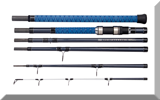
Travel rods are made for the angler on the move.
They're capable of being broken down into short sections, so that they'll fit into:~
- the boot of a car (that's the trunk, if you're an American);
- a cockpit locker on a boat;
- an airline cabin bag
And this is achieved by manufacturing the rod either:~
- in a number of short, separate sections (a multi-sectioned, travel rod) or;
- in a telescopic format, enabling each section to slide into the one below it (a telescopic or collapsible fishing rod)
OK, perhaps they're not quite as robust as conventionally manufactured saltwater fishing rods, but they're mightily convenient at times.
And if the choice is going fishing with a travel rod or not going fishing at all, then it's not too difficult a decision for most of us!
Recent Articles


-
Sea Fishing Rods and Reels Must Be Compatible for a Balanced Outfit
Mar 08, 21 08:30 AM
A quality reel fitted to a quality rod doesn't necessarily make it a quality outfit. Your fishing rods and reels have to be properly matched if you're to get the best out of them, and here’s how -
Essential Lure Fishing Tips That All Saltwater Anglers Should Know
Mar 08, 21 04:51 AM
Which single lure fishing tip applies to trolling, jigging, baitcasting, spinning, fly fishing and any other branch of lure fishing? Well, it is the one at the top of this list -
Vital Jig Fishing Tips That You Really Cannot Afford To Miss!
Mar 07, 21 10:20 AM
Essential jig fishing tips to help you select the right lure for successful jig fishing, together with the techniques required to get the most out of your jig fishing outfit

FTC Disclosure: In some of the articles on this site, I endorse some items of fishing gear. If you buy something through a link, I receive a small commission with no additional cost to you. Thank you for supporting this site. It is much appreciated.
New! Comments
Have your say about what you've just read! Leave me a comment in the box below.