- Home
- Knots and Crimping
Saltwater Fishing Knots and Crimped Connections
All saltwater fishing knots have one thing in common - they weaken the line they're tied in. The single characteristic of all good fishing knots is that the degree of the inevitable weakness is as little as possible.
A good fishing knot, properly tied, will reduce the strength of the line by about 20% - a poor one, or a good one tied carelessly, by 50% or more, so it's important to know the right one to use and to be able to tie it properly.
A large part of tying it properly is making sure the line is moistened (accurately applied saliva is good for this) before pulling the knot smoothly together, whilst ensuring that all loops come together evenly so that the entire knot absorbs the forces that will be imposed upon it.
Whole books have been written about saltwater fishing knots. There's more than one knot for any particular application, and there's often more than one way of tying it. But relax - you only need to know one good knot for each application, and the ones you really need are described here.
Saltwater Fishing Knots...
The Arbor Knot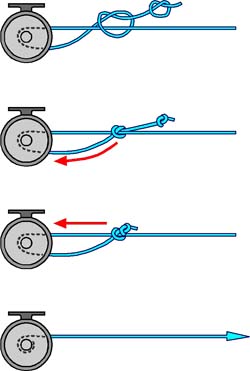 Tying the Arbor Knot Tying the Arbor Knot |
If you can tie a simple overhand knot, you can tie an arbour knot. Use it to connect your fishing line to your reel spool, or your handline to a yo-yo. This is probably the first knot you’ll tie and couldn’t be simpler.
Wind the line onto the reel and it’s time to go fishing! |
The Uni-knot
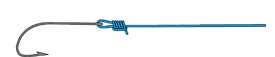 |
If you decided to learn how to tie just one saltwater fishing knot - make sure it's the Uni-Knot! As one of the easiest fishing knots to tie, and with a breaking strength only slightly less than the line it's tied in, you can use it to attach the line to your swivels, hooks and lures (although the Rapala Knot is a better knot to use for lures) and also to join two lines together. |
The Braid Knot
 |
The Braid Knot is the most secure way of connecting a swivel to braid lines. It's been designed to deal with the special qualities of today's hi-tech braided lines, which can have a tendency to slip when tied with some other knots. |
The Snood Knot (or Snell Knot)
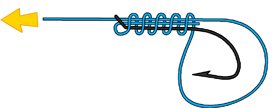 |
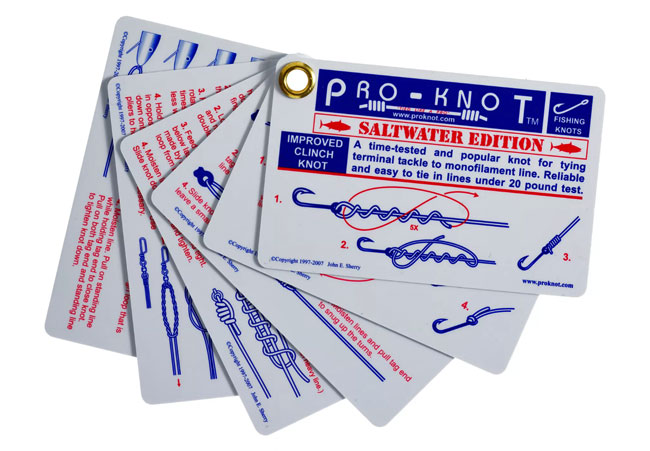
The Snood Knot is the one to use for joining mono to hooks with cranked eyes, where it will hold the hook shank in-line with the hook length rather than allowing it to rotate, as would a Uni-Knot.
Conversely, it shouldn't be used on hooks with straight eyes, as it will hold them off at an angle - use the Uni-Knot for those. |
The Dropper Loop
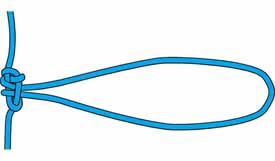 |
The Dropper Loop (also known as both a blood loop and a snood loop) is designed to stand off from the line at 90 degrees - and therein lies the problem. No line likes a sharp bend like this - it will always create internal stresses resulting in an inherent weakness. But the version described here is one of the strongest. |
The Albright Knot
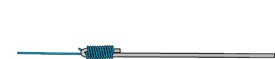 |
The Albright Knot, sometimes known as the Albright Special Knot, is a saltwater fishing knot developed specifically for joining mono line to a single strand wire leader without having to use a barrel swivel at the connection. |
The Haywire Twist
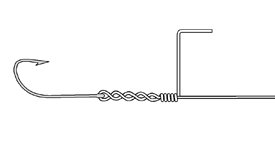 |
Not a dance style from the early sixties as you may first think, the Haywire Twist is the way to connect single-strand wire leaders to lures, swivels and hooks. |
The Rapala Knot
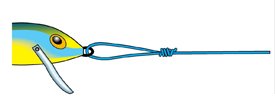 |
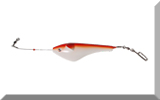
To attach your lure to a mono leader of less than 50lb breaking strain, the Rapala Knot is the best way to go. This knot doesn't snug up tight to the lure, but creates a loop which gives the lure freedom to move as its designers intended. For larger diameter mono, and all multi-strand wire line, you'll need to use a crimped connection. For a single-strand wire leader, the Haywire Twist is your only option. |
The Leader Knots
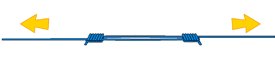 Here's how to tie the Leader Knots you need for connecting all types of line types and diameters. |
Special leader knots are required for connecting the main line to the leader. And this is not always straightforward. For instance, the lines may be of two completely different materials, or of very different diameters. |
Worth Remembering ...
Just a few knots will meet all your saltwater fishing needs, but
- make sure to use the right one for the type of line you're tying it with.
- Learn each one thoroughly and tie them with care.
- Always inspect the knot after you've tied it.
- Does it look right? If not, cut it off and tie it again until it does.
- Nothing beats a pair of nail clippers for nipping off the ends of all but the heaviest monofilament.
Crimped Connections...
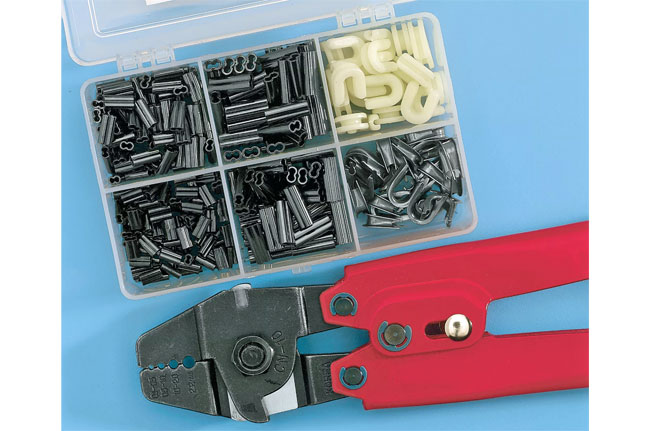
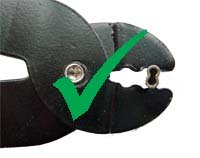 |
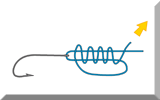
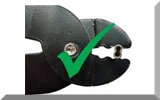
You'll find it next to impossible to tie any of the above saltwater fishing knots in monofilament line much heavier than 150lb breaking strain, and absolutely impossible in any type of wire line. Crimped connections are the only way to go for heavy mono, nylon-covered wire and cable. Even crimps won't hold in single strand wire; use the Haywire Twist knot for all connections in this material. |
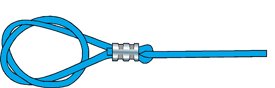
|
Use it as an alternative to rig tubing to create a reinforced loop in heavy mono line. Note the requirement for a crimped sleeve to finish it off. |
And that, I believe, is all the saltwater fishing knots you'll ever need!
Recent Articles


-
Sea Fishing Rods and Reels Must Be Compatible for a Balanced Outfit
Mar 08, 21 08:30 AM
A quality reel fitted to a quality rod doesn't necessarily make it a quality outfit. Your fishing rods and reels have to be properly matched if you're to get the best out of them, and here’s how -
Essential Lure Fishing Tips That All Saltwater Anglers Should Know
Mar 08, 21 04:51 AM
Which single lure fishing tip applies to trolling, jigging, baitcasting, spinning, fly fishing and any other branch of lure fishing? Well, it is the one at the top of this list -
Vital Jig Fishing Tips That You Really Cannot Afford To Miss!
Mar 07, 21 10:20 AM
Essential jig fishing tips to help you select the right lure for successful jig fishing, together with the techniques required to get the most out of your jig fishing outfit

FTC Disclosure: In some of the articles on this site, I endorse some items of fishing gear. If you buy something through a link, I receive a small commission with no additional cost to you. Thank you for supporting this site. It is much appreciated.
New! Comments
Have your say about what you've just read! Leave me a comment in the box below.