- Home
- All About Reels
All About Saltwater Fishing Reels
Saltwater fishing reels are the most mechanically complex items of our treasured fishing equipment. When they fail it's likely to spell the end of that particular fishing trip. A day wasted and an opportunity lost.
So it's essential we choose one that's properly designed and manufactured, and fit for our intended purpose.
But clearly we can't expect one type of reel to meet all of our requirements, which is why some are designed primarily to cast long distances and be capable of rapid retrieve, while others (particularly the big game reels) need the capacity to hold large quantities of line together with powerful drag mechanisms to subdue hard-fighting ocean gamefish.
So let's take a look at them...
Types of Saltwater Fishing Reels
On this page...
There are three basic designs of saltwater fishing reels:~
- Conventional Reels (or Multiplier Reels as they're known in the UK), or
- Fixed Spool Reels (or Spinning Reels), and
- Drum Reels (or Centre-Pin Reels) - There are many freshwater versions, but just the one true saltwater fishing reel of this type in current production as far as I'm aware, the Australian-made Alvey Reel.
All three types of saltwater fishing reels are used for both shore fishing and boat fishing, but with differing degrees of success in certain applications.
Conventional Reels
If a reel is designed to be used on top of the rod, rather than beneath it, with its spool spindle perpendicular to the rod - then it's a conventional reel.
Smaller versions designed primarily for casting applications are known as baitcasting reels, or 'baitcasters', with the term conventional reel more often associated with bottom fishing, jigging or trolling from a boat.
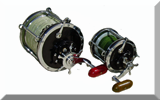
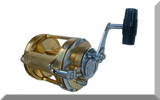
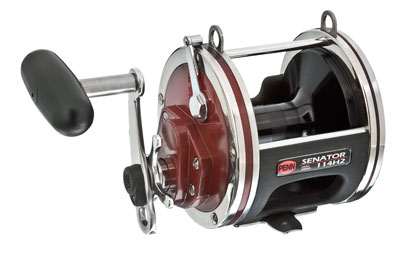 A typical conventional reel intended for boat fishing.
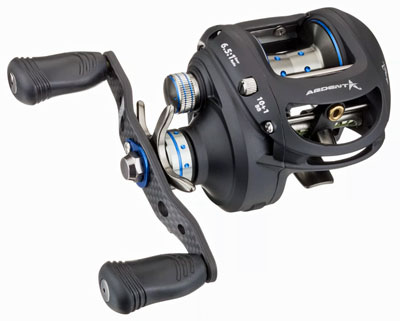 The Ardent Apex Magnum Baitcaster Reel
Examples of Conventional Reels...
Key Features of Conventional Reels
- On the cheaper casting models, the small diameter spool revolves very rapidly during the cast, leading in inexperienced hands to spectacular over-runs and backlashes;
- This problem is largely eliminated on more sophisticated casting versions with magnetic braking systems;
- Once mastered, exceptionally long casts can be made;
- The retrieve rate is initially slow, but accelerates gradually as line builds up on the spool, increasing its effective diameter as it does;
- Not suitable for very small diameter braided lines;
- Larger versions can't be used for casting;
- Steel spool versions can be used for wire line fishing
Need more detailed information about conventional reels? Such as...
- reel sizing convention?
- spool capacities?
- free-spool release systems?
- spool braking systems?
- dual-speed systems?
- star drag systems?
- lever drag systems?
- line capacities?
Yes? Then Click Here for more info on Conventional Reels...
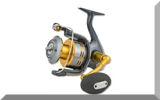
Spinning Reels
The spool on a spinning reel doesn't rotate during either the cast or the retrieve, which explains why it's also called a 'fixed-spool' reel.
During the cast the line slips over the rim of the spool, which is why spinning reels are unbeatable for casting light lures and float tackle.
The fixed spool does necessitate the added complication of a bale arm, to wrap the line around the spool and distribute it evenly through an oscillating mechanism.
Key Features of Spinning Reels
- No revolving spool, so overruns and tangles don't happen;
- Large diameter spool gives high retrieve rate - a very useful attribute when fishing over broken ground;
- Spools can be changed quickly, often by the push of a button;
- The best reel type for casting light lures long distances.
Need more detailed information about spinning reels? Such as...
- Drag Systems?
- Anti-Reverse Mechanisms?
- Oscillating Line Lay Systems?
Yes? Then Click Here for more info on the Very Best Spinning Reels...
Drum Reels
Gone are the days of the old wooden, knuckle bashing drum reels - they've been replaced by far more efficient and user-friendly models like the Alvey reel.
Try asking any fisherman to name Australian made fishing reels, and it's a safe bet that Alvey will be at the top of his list.
Alvey reels are powerful, robust and have an elegant simplicity of design. They come with a smooth and powerful star drag, or lever braking systems on some models, and are ideal as part of a wire line system.
Specialised surf-casting models are designed to be rotated through 90 degrees enabling a casting function, much in the way of a fixed spool reel. These are rightly popular with Aussie surfcasters in particular, the best of whom can achieve monumental distances.
- There's no revolving spool in casting mode, so overruns and backlashes don't happen;
- Large diameter spool gives high retrieve rate - a very useful attribute when fishing over broken ground;
- Simple, robust and easy to use.
And yes, you can mark me down as a fan of Alvey reels.
and finally...
Saltwater Fishing reels of any kind will be the most mechanically complex item of fishing equipment in your tackle box. Like all items of saltwater fishing gear, it's advisable to buy the best you can afford.
But although there are plenty of cheap saltwater fishing reels out there, most will turn out not to be the bargain they first appear to be - so buy with care.
Recent Articles


-
Sea Fishing Rods and Reels Must Be Compatible for a Balanced Outfit
Mar 08, 21 08:30 AM
A quality reel fitted to a quality rod doesn't necessarily make it a quality outfit. Your fishing rods and reels have to be properly matched if you're to get the best out of them, and here’s how -
Essential Lure Fishing Tips That All Saltwater Anglers Should Know
Mar 08, 21 04:51 AM
Which single lure fishing tip applies to trolling, jigging, baitcasting, spinning, fly fishing and any other branch of lure fishing? Well, it is the one at the top of this list -
Vital Jig Fishing Tips That You Really Cannot Afford To Miss!
Mar 07, 21 10:20 AM
Essential jig fishing tips to help you select the right lure for successful jig fishing, together with the techniques required to get the most out of your jig fishing outfit

FTC Disclosure: In some of the articles on this site, I endorse some items of fishing gear. If you buy something through a link, I receive a small commission with no additional cost to you. Thank you for supporting this site. It is much appreciated.

New! Comments
Have your say about what you've just read! Leave me a comment in the box below.