- Home
- Cleaning Your Catch
Make Cleaning Fish Easy by Using the Right Tools and the Best Methods
Cleaning fish is probably the least enjoyable part of the catch-clean-cook-eat process, but it must be done.
If you learn the best methods and use the right tools, cleaning fish is much easier than it might otherwise be.
And it's important to get it right - after all, you’re going to eat it.
So here we'll take a look not just at the cleaning and gutting techniques, but also at the preparation for cooking.
First though, the fish must be killed quickly to avoid any unnecessary suffering.
How to Kill the Fish
There are several ways of getting this unpleasant business out of the way. Your choices are:~
On this page...
- Do nothing, just leave it to suffocate slowly. Please don't;
- Hit it on the head with something hard and heavy. This is fine if you're ashore, but not so good on a boat - particularly with a large fish. Not only will it take several solid blows to get the job done, you're likely to damage the boat - and yourself!
- Use an ice-pick to destroy the fish's brain. Providing you know where it is and are accurate with the ice-pick, this will get the job done quickly and painlessly;
- Pour or squirt a little alcohol directly into the fish's gills not your best malt, any old rot gut will do the trick. This will be absorbed almost instantly into the bloodstream and will rapidly cause brain-death. It's a clean and humane method, and is the one I use most.
Feel free to use a drop more to toast the fish's
passing!
Next, Bleeding the Fish
Why would you want to do this? Well, if your catch is a hard-fighting gamefish and has had to endure a long, hard struggle before you managed to land it, lactic acid will have built up in its muscle fibre, which can potentially taint the taste of the flesh.
This is particularly true of tuna. Bleeding the fish immediately after killing it - preferably before its heart stops beating - will remove any such taint. All sushi grade fish is bled in this way.
Here's where to make the cuts that will properly bleed the fish:~
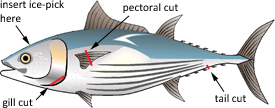 Where to make the cuts on a big fish
- Lift the gill cover and cut into the whitish membrane between the red gill filaments and the gill cover. This will sever the arteries carrying blood to the gills. Now turn the fish over and do the same to the other gill;
- Next lift up the pectoral fin and make a short, shallow transverse cut under the fin where shown, which will sever another main blood vessel. Do the same on the other side;
- Finally, make a shallow cut between the finlets at the tail-end of the fish. This will probably be less productive blood-wise than the cuts in the other regions.
Blood should now be flowing freely from each of these cuts. If it isn't, make the cuts deeper, or longer, or in a slightly different position until it is.
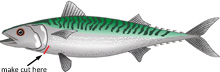 Where to make the cuts on a small fish
Small fish like atlantic mackerel should be clubbed smartly on the head, and have their throat cut below the gills. Swill them around in a bucket of seawater until the blood stops flowing.
Ocean gamefish are conveniently equipped with a narrow, wrist-like tail section and a strong, broad caudal fin (the tail fin) which enables you to safely hitch a tail rope around them. Do this now and tow it astern for 10 minutes or so to let the fish bleed out. Watch out for sharks! Use these ten minutes to wash down your cockpit, which will be looking rather colourful.
Read more about gutting fish...
An Essential Safety Tip
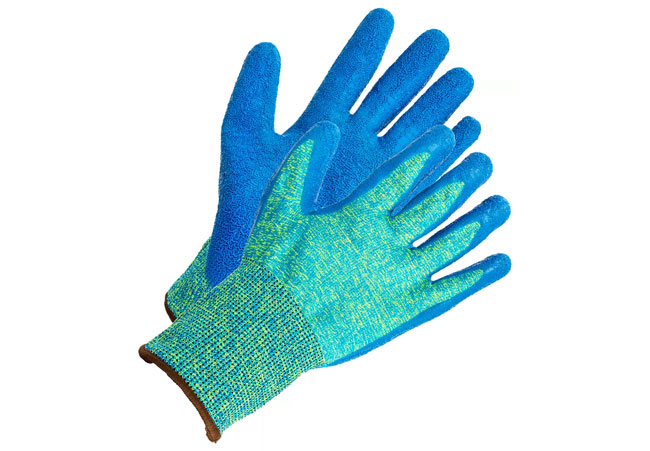
Always wear a cut-proof fishing glove when cleaning fish - obviously on the hand that isn't holding the knife (yes, I've seen it done).
These are constructed with a cut-resistant stainless-steel core wrapped in a high-tech polyester and vinyl material. Sharp points will penetrate them but a slicing blade won't. I've been very thankful that I was wearing one of these on more than one occasion when cleaning fish.
But back to the job in hand. With the fish lying limp and bloodless, and with your tools for cleaning fish to hand, you can now begin gutting the fish.
You'll need to remove the fish's internal organs first, as the bacteria living in the gut will rapidly cause the flesh to deteriorate if you don't.
Cleaning fish can be a messy business, but with practice this method of cleaning fish will make light work of it.
First though, decide how you want to prepare your fish for the table. Why? Well, if you choose to fillet it, you won't have to bother with the fish cleaning bit. Otherwise there are various parts of the fish you'll need to remove.
These are your main options:~
Filleting It
You're going to need a finely honed filleting knife for this, together with some means of keeping that edge razor sharp.
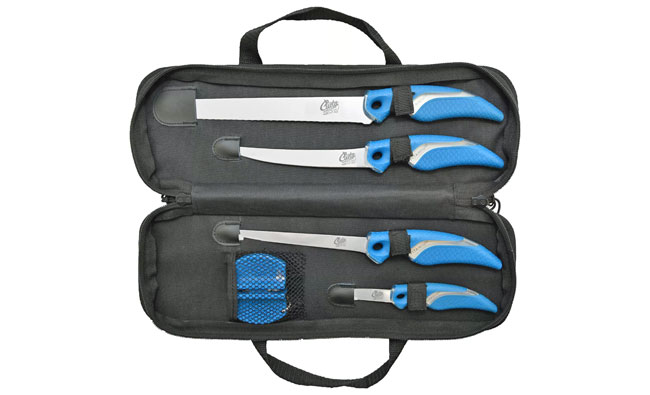
Some fish lend themselves more to the filleting approach than others. It's largely a matter of body shape.
Laterally compressed fish (that's when they look tall and relatively slim when viewed head on - or wide and very slim in the case of flatfish) are ideal candidates, whilst round sectioned fish like tuna and wahoo for instance are best steaked - that's sliced into cutlets.
Not only is there no need for cleaning fish at all if you fillet them, if you go on to skin the fillet, you won't need to scale them either.
And the easiest fish of all to prepare? Skates and rays. Cleaning squid, octopus and cuttlefish is a straightforward affair too - once you know how to do it.
Read more about filleting fish...
Steaking It
Unlike filleting, where both sides of the fish are removed independently, steaking requires that the fish is scaled, de-finned and cleaned first. Then...
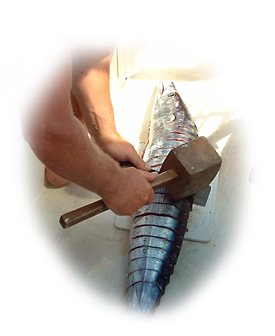 Steaking a King Mackerel
- With the fish laying on its side, mark out the steaks with a sharp knife. The thickness of the steaks is down to you, but I like mine about 1" or so;
- Then return to each of the marks and cut right down to the backbone. Don't try and cut through it, or you'll ruin the cutting edge of your knife;
- Next you'll need a cleaver - or a machete - and a something heavy to hit it with. I use a wooden mallet. Give the cleaver a sharp clout to cut through the backbone for each steak;
- Finally, use your knife to complete the cut right through each of the steaks.
Leaving it Whole
Scale it, gut it, remove the gills if you're leaving the head on, and grill it on the barbie. A perfect approach for pan-sized fish.
So that's the 'cleaning fish' and 'preparation for cooking' processes taken care of. Now let's head on to 'cooking the fish'...
Recent Articles


-
Sea Fishing Rods and Reels Must Be Compatible for a Balanced Outfit
Mar 08, 21 08:30 AM
A quality reel fitted to a quality rod doesn't necessarily make it a quality outfit. Your fishing rods and reels have to be properly matched if you're to get the best out of them, and here’s how -
Essential Lure Fishing Tips That All Saltwater Anglers Should Know
Mar 08, 21 04:51 AM
Which single lure fishing tip applies to trolling, jigging, baitcasting, spinning, fly fishing and any other branch of lure fishing? Well, it is the one at the top of this list -
Vital Jig Fishing Tips That You Really Cannot Afford To Miss!
Mar 07, 21 10:20 AM
Essential jig fishing tips to help you select the right lure for successful jig fishing, together with the techniques required to get the most out of your jig fishing outfit

FTC Disclosure: In some of the articles on this site, I endorse some items of fishing gear. If you buy something through a link, I receive a small commission with no additional cost to you. Thank you for supporting this site. It is much appreciated.


New! Comments
Have your say about what you've just read! Leave me a comment in the box below.