- Home
- Fishing Tips
- Lure Fishing Tip
A Lure Fishing Tip or Two to Try on Your Next Lure Fishing Trip
Perhaps one lure fishing tip we should all be aware of is not to be seduced into buying a lure simply because it looks pretty. Some of today's saltwater fishing lures have an almost jewel-like quality about them and catch a lot more anglers than they ever will fish.
How life-like they look when they're static is irrelevant - it's their action as they're drawn through the water that matters.
Then comes quality of construction. There's not much point in having a lure with a devastating action if it falls apart as soon as it's hit by a good fish.
Is the hook the right size and strong enough, and is it in the right place? Just how well is it attached to the main body of the lure?
Lure Fishing Tip #1 ~ Leaders for Lures
As soon as I started using fluorocarbon leaders for my trolling lures, I noticed an immediate improvement in the strike rate. Now I use it for all forms of lure fishing, other than when toothy types demand that I use a wire leader - I wouldn't be without it.
The reason for this is that fluorocarbon line, having a refractive index close to that of water makes it almost invisible underwater.
Note 'almost' - it isn't quite invisible, but it's a whole lot less visible than mono or any other type of line.
Just think how much more convincing our lures must look to a fish if they're not visibly connected to a length of line.
Don't be put off by its price - Fluorocarbon line is worth it.
Lure Fishing Tip #2 ~ Main Line for Lures
For forms of lure fishing that require you to vary the rate and direction of the retrieve - as in jig fishing and baitcasting for example - you need a low-stretch line that puts you in direct contact with the lure.
Low-stretch monofilament or, better still, braid line is what you need.
Big Game Fisherman use braid line with their trolling outfits for a different reason.
Because it's so much thinner than mono of the same strength you can get a lot more of it on your reel, which means that you can use a smaller reel and a lighter, more sporting outfit.
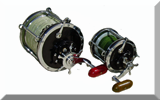
If you choose to go down this route you must check that the reel, which is now dealing with much greater loads than it was designed for, is up to the task.
Lure Fishing Tip #3 ~ Striking Features
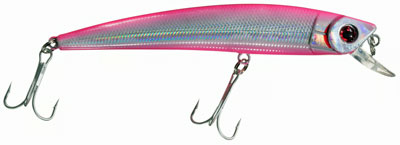
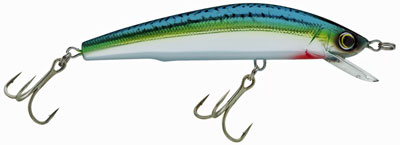
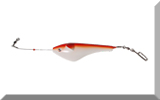
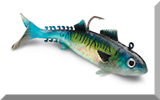
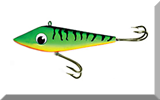
It's widely believed that big, prominent eyes on lures give something for predators to home in on, and light-reflecting internals as on this Offshore Angler Inshore Special Minnow can do no harm at all.
Lure Fishing Tip #4 ~ Do You Really Need Those Treble Hooks?
Quite a few fishing lures - the one shown above is a good example - come fitted with treble hooks, and there are three good reasons why you might want to think about replacing these with doubles, or even a single hook:~
- You have three times the opportunity for getting snagged up;
- There's a high chance of foul-hooking a fish, causing a deal of damage to it before it rips itself free;
- When unhooking your catch, it's all too easy to get a hook embedded in yourself.
Incidentally, if this happens to you at any time (and it will - it happens sooner or later to all of us) here's how to get a fish hook out of yourself.
Lure Fishing Tip #5 ~ Fish the Lure Right Up to the Rod Tip
Many predators 'shadow' a lure before deciding to hit it. To give them the maximum opportunity to make their mind up, always fish the lure right up to the rod tip when spinning and baitcasting.
Dip the rod tip below the surface to keep the lure submerged. If the lure is a suspending type, stop winding and leave it a couple of metres short of the rod tip for a few seconds.
Be ready for a hit and make sure you've got the drag set to give line.
Lure Fishing Tip #6 ~ The Right Size Hook in The Right Place
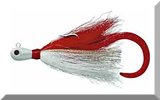
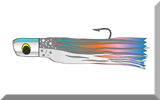
This is a particular issue for skirted trolling lures, where if the hook is too far forward, or too small it will be masked by the skirt and won't do what it's supposed to do.
 Is the hook the correct size for your skirted lure? Is the hook the correct size for your skirted lure? |
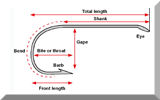
To get the hook size right, check that the gape of the hook is about the same as the width of the lure head - one hook size either way will OK. |
But if it's much smaller, the point will be masked by the skirts, and hook-ups will suffer. Much larger and it will unbalance the lure and spoil its action.
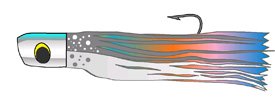 Is the hook in the right place? Is the hook in the right place? |
The hook should be positioned well aft, but not so far back that it's visible at the end of the skirt. |
|
In the illustration above it could probably do with being a little further back. Adjusting the hook position is simple - just add or remove a number of beads between the hook eye and the inside of the lurehead. |
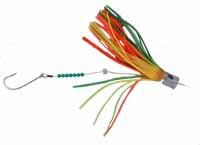 Adjust the hook position with beads Adjust the hook position with beads |
Lure Fishing Tip #7 ~ Casting Longer
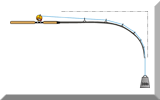
If you think you're casting short, it's tempting to add weight ahead of the lure. Big mistake, you're likely to spoil the action of lure and spook the fish. You best option is to change the lure to a longer casting model.
|
At least one manufacturer has come up with a plug design which incorporates steel balls inside the lure that locate at the back end of the plug during casting to improve distance and accuracy in flight. Artwork by Andrew Simpson |
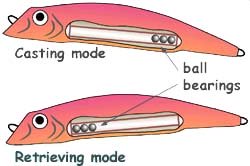 A clever design to increase casting distance A clever design to increase casting distance |
However, a lure so weighted would have a poor swimming action and catch few fish as a result. So to overcome this failing, an internal magnet pulls back the weight into its designed location once the energy of the cast is depleted.
Yo-Zuri call it 'The Magnetic Weight Transfer System' and the Mag Minnow is one of their lure types that have it.
Clever stuff!
Lure Fishing Tip #8 ~ Let the Fish See the Lure
There's much to be said for fishing your lure close to, or even on, the surface. Here the fish below will see it silhouetted against the light, and will rocket from the depths to take a crack at it.
Fished deeper, the lure won't be as easy to spot against the seabed, and few fish above the lure will see it.
Recent Articles


-
Sea Fishing Rods and Reels Must Be Compatible for a Balanced Outfit
Mar 08, 21 08:30 AM
A quality reel fitted to a quality rod doesn't necessarily make it a quality outfit. Your fishing rods and reels have to be properly matched if you're to get the best out of them, and here’s how -
Essential Lure Fishing Tips That All Saltwater Anglers Should Know
Mar 08, 21 04:51 AM
Which single lure fishing tip applies to trolling, jigging, baitcasting, spinning, fly fishing and any other branch of lure fishing? Well, it is the one at the top of this list -
Vital Jig Fishing Tips That You Really Cannot Afford To Miss!
Mar 07, 21 10:20 AM
Essential jig fishing tips to help you select the right lure for successful jig fishing, together with the techniques required to get the most out of your jig fishing outfit

FTC Disclosure: In some of the articles on this site, I endorse some items of fishing gear. If you buy something through a link, I receive a small commission with no additional cost to you. Thank you for supporting this site. It is much appreciated.



New! Comments
Have your say about what you've just read! Leave me a comment in the box below.