- Home
- Artificial Lures
- Daisy Chain
Rig a Daisy Chain to Bring More Fish to your Trolling Lure!
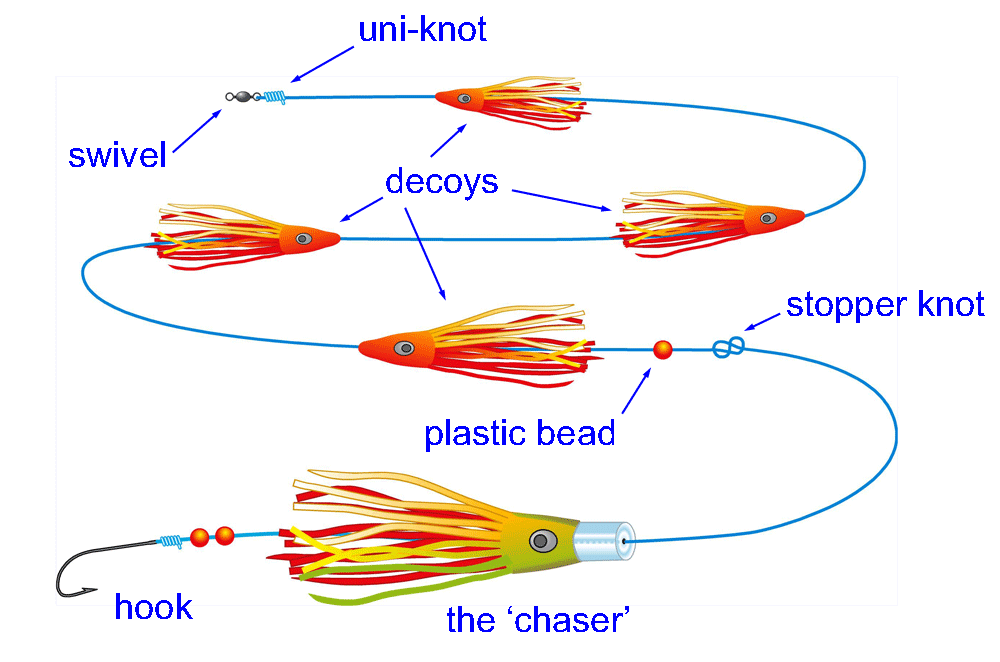
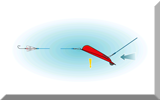
A daisy chain is simply a string of teasers (hookless lures used as attention-getting decoys) rigged together line-astern for deployment ahead of your trolling lure.
If you're trolling with just one or two lines rather than a full spread, having a daisy chain on one of them - with or without a bird teaser up front - is probably the single most effective thing you can do to improve your strike rate.
This will create visual and sonic disturbance in the water - noise, as it's called - which to a curious predator gives the appearance of a small shoal of baitfish with a straggler (the 'chaser' - your lure) struggling to keep in touch.
It won't take a leap of imagination to guess which one's going to get hit!
How to Rig a Daisy Chain
Putting one together is a straightforward affair.
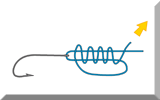
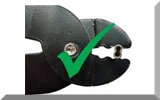
The usual approach is to use three or four plastic squid lures as the decoys, stopping each one at the appropriate position on the leader by either an overhand knot or by crimping on a sleeve.
Tie your stopper knots 2 to 3 feet apart, depending on the size of the decoy.
A small bead ahead of the knot will prevent the knot (or crimped-on sleeve) pulling through.
The chaser, which unlike the decoys - and rather obviously - is rigged with a hook attached at the end of the leader. It can be the same size and pattern as the others, or maybe the next size up - but not smaller.
Remember to position the hook correctly within the chaser's skirt by threading on beads ahead of the hook.
 The decoys catch the fish's attention; the chaser catches the fish!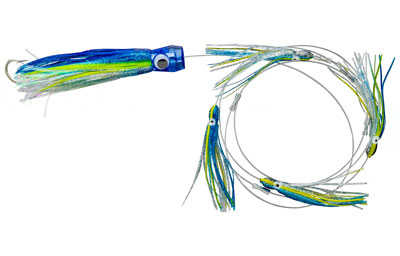
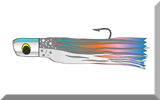
They're particularly suited for use with trolling handlines. If you do choose to make one up yourself, these soft bait squid make excellent teasers.
Some of the daisy-chain decoys will occasionally break the surface picking up air and leaving an impressive smoke trail in their wake - a real wake-up call for any predators lurking nearby.
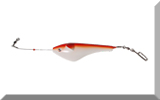
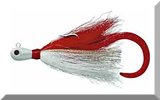
But if you don't want to go to the trouble of making up your own, you could buy one already made up like the JAW lures version shown here.
Include a Bird Teaser in the Rig?
For noise of truly orchestral proportions, why not rig a bird ahead of your string of decoys?
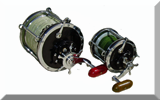
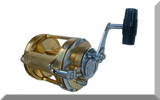
This is what we do when making an offshore passage aboard our sailboat Alacazam, where one of our trolling lines is deployed from a Penn Senator reel bolted directly to the pushpit.
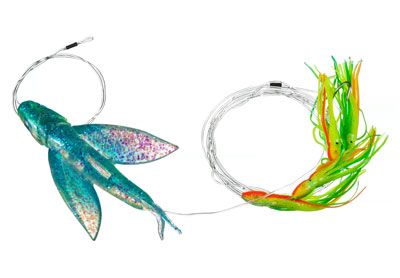
What's a bird? It's just another type of decoy that's designed to splash around on the surface, pretending to be a shoal of unsuspecting baitfish.
My 'standard' rig for this is a bird attached to a string of bulb squid decoys with a slightly larger one as the chaser. It gets results!
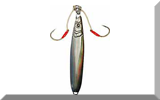
But you won't be able to use a bird with a heavy string of decoys - steel jetheads for instance - as the drag will pull the bird below the surface.
To be sure this won't happen, you could buy a complete rig, like the Carolina Lures version offered here...
Top Tip ~ Use a Snap Link!
Whilst all this hardware is no problem on a trolling handline, it's not ideal - particularly if you've got a bird splashing around up front - on a rod and line outfit. But there's an easy solution:~
- Rig your daisy chain on its own separate line;
- Remove the chaser and replace it with a snaplink;
- Connect your leader a short distance ahead of your lure directly to the snaplink with an elastic band.
Now, when a fish hits your lure, the elastic band breaks leaving you clear to fight it without the daisy chain being dragged around all over the ocean. And this would be a good time to get it back aboard before something else eats it!
Next ~ A Spreader Bar Perhaps?
Recent Articles


-
Sea Fishing Rods and Reels Must Be Compatible for a Balanced Outfit
Mar 08, 21 08:30 AM
A quality reel fitted to a quality rod doesn't necessarily make it a quality outfit. Your fishing rods and reels have to be properly matched if you're to get the best out of them, and here’s how -
Essential Lure Fishing Tips That All Saltwater Anglers Should Know
Mar 08, 21 04:51 AM
Which single lure fishing tip applies to trolling, jigging, baitcasting, spinning, fly fishing and any other branch of lure fishing? Well, it is the one at the top of this list -
Vital Jig Fishing Tips That You Really Cannot Afford To Miss!
Mar 07, 21 10:20 AM
Essential jig fishing tips to help you select the right lure for successful jig fishing, together with the techniques required to get the most out of your jig fishing outfit

FTC Disclosure: In some of the articles on this site, I endorse some items of fishing gear. If you buy something through a link, I receive a small commission with no additional cost to you. Thank you for supporting this site. It is much appreciated.


New! Comments
Have your say about what you've just read! Leave me a comment in the box below.