- Home
- Artificial Lures
- Fishing Spoons
Getting the Best out of
Fishing Spoons and Spinners
Saltwater fishing spoons and spinners are shiny metal lures fitted with a rear-mounted hook - either a single or a treble - that attract fish by flashing and vibrating as they're drawn through the water.
These lures are equally at home being cast from the shore or drifting boat, or trolled astern of a boat underway.
OK, the smallest of spinners won't be very effective as a trolling lure except when fishing for the humble (but succulent) atlantic mackerel, but a large spoon - fished deep on downrigger or planer gear - will be just the thing for larger ocean predators.
But what's the difference between spinners and fishing spoons other than size? Let's take a look...
Is it a Saltwater Fishing Spoon, or is it a Spinner?
Spinners are constructed as a metal bar with a hook at one end and an attachment ring (or a swivel in some cases) at the other.
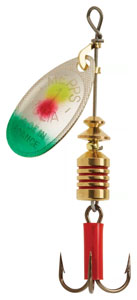
A metal blade is attached - usually by one end only - to the bar. As the spinner is drawn through the water the blade spins rapidly around the bar, flashing and emitting vibrations as it does so.
Spinners are really intended for casting - not used as trolling lures - but for small fish, particularly mackerel, they can work well when towed slowly astern.
The one shown here is something of a classic - the Mepps Aglia Original Plain Spinner.
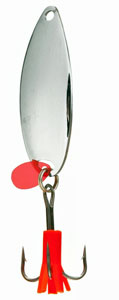
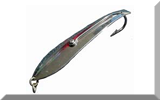
Fishing spoons are even simpler, just a curved metal plate with a hook at one end and an attachment ring at the other.
They don't spin rapidly - although they may rotate occasionally - but perform in a much more restrained manner, wobbling and fluttering in the water, sending out pulsating vibrations and penetrating flashes.
This one is a Johnson Original Sprite Spoon.
Fishing Spoons and Spinners for Atlantic Mackerel, Pollack and Bass
The ubiquitous mackerel spinner shown here is different from most other spinners in that its blade is attached to a hollow tube over its whole length, all of which rotates around the bar.
It seems that other fish know that it's reserved for mackerel - I've never caught anything else on them.
They come supplied with a low quality treble hook, which soon rusts. I always replace this with a single hook - the mackerel don't seem to mind.
The Mepps Aglia shown at the top of the page has no such reservations on it. Not only does it cast well, but used as a trolling lure at low speeds (2 knots maximum), no self-respecting bass will ignore it.
With either of these small lures you'll need an appropriately sized trolling weight - or a paravane - on the line, or they'll just skip playfully around on the surface, attracting nothing but the occasional quizzical eye of a seagull.

Mackerel
won't turn their nose up at small fishing spoons used as trolling
lures. Particularly when, with a seabass in mind, you'd rather they did.
To avoid the mackerel, step up the lure size.
Try one of the Acme Kastmaster Spoons, shown here. This stainless-steel lure comes is several sizes, casts like a bullet, trolls sub-surface, and works equally well as a jig.
If I were confined to having just one lure in my tackle box, it would be this one - as long as I could have a bucktail jig to keep it company.
Larger Fishing Spoons for Offshore Trolling
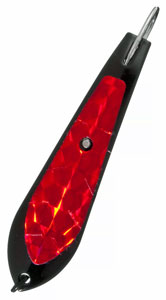
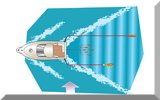
For a sailing boat, ghosting along in light airs at 2 knots or so these are ideal lures to rig on your trolling line.
I use one of the 51/2" Huntington Drone Spoons, which like the Clarkespoon, has the hook rigidly bolted on.
Like all spoons it has a tendency to put twists in the line, so the use of good quality ball-bearing swivels is essential.
If, despite all precautions, twists develop, remove your rig and trail all of your line astern to allow it to unwind.
Bunker Spoons
Bunker are fish of the herring family, and they're also known as shad, pogi and menhaden. They're found on the eastern seaboard of the United States, and are a favourite foodfish of striped bass and bluefish.
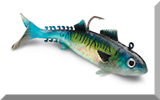
Bunker Spoons are designed to emulate them. These are large and heavily weighted - up to 14 inches (350mm) long and over 1lb in weight.
They're fished deep - often on wire line - and slow, between 2.5 and 3.5 knots.
Striped bass reach up to 80lb in weight - what a shame they can't be encouraged to make their way across to our side of the Atlantic!
Given the opportunity, tuna and wahoo are a bit partial to these lures too.
Storing your Rigged Trolling Spoons
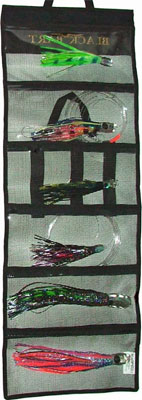
Before stowing your trolling spoons away after a day's fishing, rinse them off in fresh water to remove the salt.
Once they've dried, a quick squirt of moisture repellent lubricant on the swivels and hooks will help keep corrosion at bay.
To eliminate tangles and protect the hook points you should store your rigged trolling lures in lure bags like the Black Bart Lure Bag shown here.
The ideal trolling lure bag should have a breathable vinyl back - in case the lures aren't quite dry when you put them away - and a clear front, so you can see what's inside.
Coil the leaders and store one trolling lure to a pocket.
Recent Articles


-
Sea Fishing Rods and Reels Must Be Compatible for a Balanced Outfit
Mar 08, 21 08:30 AM
A quality reel fitted to a quality rod doesn't necessarily make it a quality outfit. Your fishing rods and reels have to be properly matched if you're to get the best out of them, and here’s how -
Essential Lure Fishing Tips That All Saltwater Anglers Should Know
Mar 08, 21 04:51 AM
Which single lure fishing tip applies to trolling, jigging, baitcasting, spinning, fly fishing and any other branch of lure fishing? Well, it is the one at the top of this list -
Vital Jig Fishing Tips That You Really Cannot Afford To Miss!
Mar 07, 21 10:20 AM
Essential jig fishing tips to help you select the right lure for successful jig fishing, together with the techniques required to get the most out of your jig fishing outfit

FTC Disclosure: In some of the articles on this site, I endorse some items of fishing gear. If you buy something through a link, I receive a small commission with no additional cost to you. Thank you for supporting this site. It is much appreciated.


New! Comments
Have your say about what you've just read! Leave me a comment in the box below.