- Home
- Fishing Line
- Nylon Fishing Line
Will Nylon Fishing Line
Meet All Your Needs?
Many saltwater fishermen use nylon fishing line - also known as 'monofilament line, or just plain 'mono' line' - pretty much exclusively, but there are situations when one of the more modern materials would be better.
For example fluorocarbon line, a sort of hi-tech monofilament cousin of nylon fishing line is better when near-invisibility is important, and braid line is when non-stretch and minimum diameter is required.
Nylon line is made from liquid nylon, by drawing it out in a continuous strand until it has reached a desired diameter, and an associated breaking strains.
Not all nylon monofilament lines are equal though, some are thinner for the same strength than others, and there are varying degrees of hardness and stiffness to look out for.
The best nylon fishing lines have a good, consistence strength/diameter ratio, and are soft and supple.
Like most items of fishing tackle, you get what you pay for, and the very cheapest nylon fishing lines seldom represent the best value.
Modern high quality nylon lines are consistent in both strength and diameter when new, but even the best of them eventually wear out through use.
A major culprit is ultra-violet light, a component of sunlight, which causes a structural change in the line and a resultant decrease in its breaking strain. This together with the nicks and abrasions that always occurs in use means it should be changed regularly, or you risk losing that fish of a lifetime.
So nylon line makes a good general purpose reel line, and is fine for leaders and making up terminal tackle. But its properties don't make it the very best line material for all applications. Take a look at these following pros and cons:~
In Its Favour...
- Its elasticity give it good shock absorbing qualities, making it less likely that a fish will tear itself free of the hook in its desperate fight for freedom.
- Compared to other line materials, it's relatively inexpensive.
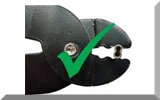
- It's an easy line material in which to make connections, using knots or crimps.
- It's transparent, and less visible in the water than most other line materials.
- It's a low memory material, so will soon forget about the coils it was restrained in on the spool.
- It's moderately resistant to abrasion
Not so good...
- Its elasticity absorbs movement of your terminal tackle, reducing bite detection at the rod tip.
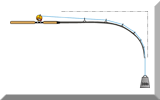
- Its elasticity works against you when you're trying to make the longest possible cast, where it absorbs energy that is better transferred to the rod. Shock leaders for casting should always be made from low-stretch nylon fishing line specifically produced for this application, or the much more expensive fluorocarbon lines.
- It suffers from ultra-violet degradation when exposed to direct sunlight.
- It's absorbent to a small degree, a property that causes it to loose strength over time
So nylon fishing line makes a good general purpose line - but it's not perfect for all applications. But then neither is anything else...
Bulk Spools
The very best value is to be had by buying monofilament fishing line in bulk.
Some suppliers offer this as a series of normal sized spools joined together, whilst others choose to load it all on to a single large spool and sell it by breaking strain and weight - for example a 2lb spool of 40lb breaking strain line - but fail to tell you what length of line you're getting.
In this latter case, the following table will give you the approximate answer:~
| Bulk Spool Weight | ||||||||||
| 1 lb | 2 lb | 3 lb | 5 lb | 9 lb | ||||||
Line BS |
yds | m | yds | m | yds | m | yds | m | yds | m |
10 lb |
5,400 | 4,860 | 10,800 | 9,720 | . | . | . | . | . | . |
12 lb |
4,000 | 3,600 | 8,000 | 7,200 | . | . | . | . | . | . |
15 lb |
3,000 | 2,700 | 6,000 | 5,400 | . | . | . | . | . | . |
20 lb |
2,400 | 2,160 | 4,800 | 4,320 | . | . | . | . | . | . |
25 lb |
2,000 | 1,800 | 4,000 | 3,600 | . | . | . | . | . | . |
30 lb |
1,600 | 1,440 | 3,200 | 2,880 | 4,800 | 4,320 | 8,000 | 7,200 | 14,400 | 12,960 |
40 lb |
1,400 | 1,260 | 2,800 | 2,520 | 4,200 | 3,780 | 7,000 | 6,300 | 12,600 | 11,340 |
50 lb |
1,000 | 900 | 2,000 | 1,800 | 3,000 | 2,700 | 5,000 | 4,500 | 9,000 | 8,100 |
60 lb |
800 | 720 | 1,600 | 1,440 | 2,400 | 2,160 | 3,500 | 3,150 | 7,200 | 6,480 |
80 lb |
600 | 540 | 1,200 | 1,080 | 1,800 | 1,620 | 3,000 | 2,700 | 5,400 | 4,860 |
100 lb |
500 | 450 | 1,000 | 900 | 1,500 | 1,350 | 2,400 | 2,160 | 4,500 | 4,050 |
125 lb |
300 | 270 | 600 | 540 | 900 | 810 | 1,500 | 1,350 | 2,700 | 2,430 |
150 lb |
250 | 225 | 500 | 450 | 750 | 675 | 1,425 | 1,282 | 2,250 | 2,025 |
200 lb |
200 | 180 | 400 | 360 | 600 | 540 | 1,225 | 1,102 | 1,800 | 1,620 |
250 lb |
150 | 135 | 300 | 270 | 450 | 405 | 850 | 675 | 1,350 | 1,215 |
300 lb |
135 | 121 | 270 | 243 | 405 | 364 | 675 | 610 | 1,215 | 1,093 |
400 lb |
125 | 112 | 250 | 224 | 375 | 337 | 625 | 560 | 1,125 | 1,012 |
Recent Articles


-
Sea Fishing Rods and Reels Must Be Compatible for a Balanced Outfit
Mar 08, 21 08:30 AM
A quality reel fitted to a quality rod doesn't necessarily make it a quality outfit. Your fishing rods and reels have to be properly matched if you're to get the best out of them, and here’s how -
Essential Lure Fishing Tips That All Saltwater Anglers Should Know
Mar 08, 21 04:51 AM
Which single lure fishing tip applies to trolling, jigging, baitcasting, spinning, fly fishing and any other branch of lure fishing? Well, it is the one at the top of this list -
Vital Jig Fishing Tips That You Really Cannot Afford To Miss!
Mar 07, 21 10:20 AM
Essential jig fishing tips to help you select the right lure for successful jig fishing, together with the techniques required to get the most out of your jig fishing outfit

FTC Disclosure: In some of the articles on this site, I endorse some items of fishing gear. If you buy something through a link, I receive a small commission with no additional cost to you. Thank you for supporting this site. It is much appreciated.
New! Comments
Have your say about what you've just read! Leave me a comment in the box below.