- Home
- Fishing Line
- Fluorocarbon Fishing Line
Fluorocarbon Fishing Line -
It's Almost Invisible!
Unlike standard monofilament line, fluorocarbon fishing line isn't
derived from nylon, but from a polymer known as polyvinylidene fluoride. As fascinating as this may be, what difference does it make for us fishermen?
Well, it makes quite a lot of difference - with one really significant benefit over plain old nylon monofilament line.
One of the good things about fluorocarbon fishing line is that it has an unusually low refractive index - close to to that of water - which makes it almost invisible when it's in the water.
Wonderful news for us; not so good for the fish!
And there's more...
- Fluorocarbon fishing line has a harder surface texture than mono, and doesn't abrade to the same degree when fishing on coarse sand and rough ground.
- It's far more resistance to ultra-violet light, so exposure to sunlight won't affect it like it does mono.
- It's much less absorbent than mono, and as a result isn't weakened by prolonged immersion in water.
But Is It Worth The Extra Cost?
Not always. Clearly it's good stuff - its greatest attraction to us anglers being its near invisibility in water, but that only counts for anything if the water itself is clear.
And it's expensive, so if you regularly fish in murky water like the Thames Estuary - or at night - then don't bother with it. Stick with the less expensive nylon line, or braid fishing lines as for you, fluoro lines won't represent good value for money.
But for those of us who fish in clear waters, my view is that the major benefits offered by fluorocarbon line justifies its high initial price. After all, anything that helps us catch more fish...
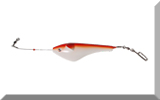
Use it for hook snoods, the line in terminal rigs, and as leaders for plugs and crankbaits - but not with topwater lures, as fluorocarbon line sinks and will spoil the action of the lure.
I now rig all my lures with Fluorocarbon Fishing Line icon when trolling in the clear water of the Caribbean, and while I can't be certain that it's improved my catch rate - maybe I've just got luckier - it seems that way to me.
But there's little benefit in using it for your main reel line. Save it for your leaders and terminal tackle.
So, to summarise...
Fluorocarbon Fishing Line - The Good, and the Not So Good
Strong points...
- It's virtually invisible under water;
- It's a low stretch material, a property that provides excellent bite detection at the rod tip;
- It's denser than water and sinks readily as a result, allowing trolling and spinning lures to run deeper;
- It doesn't absorb water like mono does, and keeps its strength longer as a result;
- It's slightly stiffer than mono, and less likely to tangle;
- Good abrasion resistance;
- Relatively high resistance to ultra-violet light.
Not so good...
- It's expensive, more than double the price of standard mono;
- It has a relatively high line memory, which means that casting distances can be affected;
- Not good for use with topwater lures, as its tendency to sink is likely to affect the action of the lure.
Just one more thing...
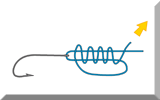
I've heard some anglers say that they've had problems getting knots to hold in fluorocarbon fishing line.
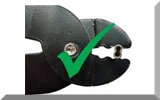
I use the Uni-Knot, or crimped connections in heavy line, and have had no such problems.
Recent Articles


-
Sea Fishing Rods and Reels Must Be Compatible for a Balanced Outfit
Mar 08, 21 08:30 AM
A quality reel fitted to a quality rod doesn't necessarily make it a quality outfit. Your fishing rods and reels have to be properly matched if you're to get the best out of them, and here’s how -
Essential Lure Fishing Tips That All Saltwater Anglers Should Know
Mar 08, 21 04:51 AM
Which single lure fishing tip applies to trolling, jigging, baitcasting, spinning, fly fishing and any other branch of lure fishing? Well, it is the one at the top of this list -
Vital Jig Fishing Tips That You Really Cannot Afford To Miss!
Mar 07, 21 10:20 AM
Essential jig fishing tips to help you select the right lure for successful jig fishing, together with the techniques required to get the most out of your jig fishing outfit

FTC Disclosure: In some of the articles on this site, I endorse some items of fishing gear. If you buy something through a link, I receive a small commission with no additional cost to you. Thank you for supporting this site. It is much appreciated.
New! Comments
Have your say about what you've just read! Leave me a comment in the box below.