- Home
- Fish Identification
- Types of Sharks
These Common Types of Sharks
Are Common No More
All types of sharks are cartilaginous fish. That is to say they don't have a bone in their body. Cartilage yes, but real bone no. Along with skates and rays, their skeleton is made of cartilage.
Another shared characteristic with skates and rays is the absence of a swim bladder, which means that if they don't want to sink like a stone they need to keep swimming.
Many sharks are under threat of extinction, largely due to the world's (and in particular China's) increasing appetite for sharks' fin soup.
The appalling practise by commercial shark fishermen of cutting off the fins and throwing the rest of the fish - still alive - back into the sea is not just unsustainable, it's utterly disgraceful.
Shark are distinctly uncuddly creatures and, being often on the receiving end of bad press internationally, this somehow seems to make such treatment acceptable.
OK, personal rant over, let's take a look at the most common types of sharks that cruise around in the Atlantic Ocean.
All artwork by Keith Linsell
Blue Shark
|
French ~ Peau bleu Italian ~ Verdesca Spanish ~ Tintorera Portuguese ~ Tintureira German ~ Grosser Blauhai |
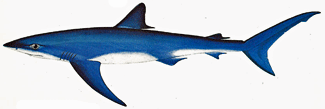 Blue Shark
|
The Blue Shark is the most plentiful of all types of sharks that frequent the Atlantic waters of Britain and Northern Europe during the summer months.
In warmer seas it is said to grow up to 20 feet, but hereabouts their average weight is around 30lb to 50lb. Even so, the British record is an excellent specimen caught off Looe in Cornwall, which tipped the scales at 218lb.
It's a beautiful fish, long and slender with a dark indigo back, bright blue flanks and a pure white underside.
Porbeagle Shark
|
French ~ Taupe Italian ~ Smeriglio Spanish ~ Cailón, Marrajo Portuguese ~ Tuberão-sardo German ~ Herringshai |
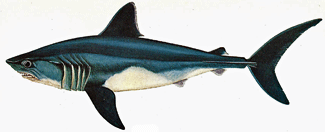 Porbeagle Shark
|
The Porbeagle Shark is much more tolerant of cold water than the Blue Shark. In fact the British record fish of 507lb was caught off Dunnet Head in the far north of Scotland.
They are known to venture close inshore in some parts, but they're more frequently found around tide races, reefs and rocky outcrops - especially if deep water is close by.
Porbeagle Shark will eat almost any fish that swims, but herring and mackerel are probably at the top of its personal hit list.
Mako Shark
|
French ~ Mako, Taupe Bleu Italian ~ Squalo Mako, Ossirina Spanish ~ Marrajo Portuguese ~ Tuberão-anequim German ~ Mako, Makrelenhai |
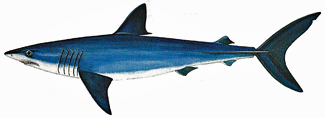 Mako Shark
|
For many shark anglers, the Mako is the king of sharks. Hook one of these and you've got a real battle on your hands. A Mako Shark has much more power and stamina than a Blue or Porbeagle of similar size, and will leap to spectacular heights in its attempt to regain its freedom.
They're a true pelagic fish of the open ocean, where they feed predominantly on mackerel, bonito and herring in the upper levels. Mako Shark grow to a huge size - the world record being over 1,000lb - and are ferocious predators. Distinctly uncuddly and definitely not one to go swimming with!
In appearance they closely resemble a large Porbeagle, but there are some key differences:~
- The Mako is a leaner fish than the Porbeagle, but less so than a Blue Shark.
- Its second dorsal fin is positioned further forward than its anal fin, whereas on the Porbeagle, both fins are in line.
- The leading edge of the dorsal fin is aft of the trailing edge of the pectoral fin, whereas the Porbeagle's dorsal fin commences further forward.
- The Mako's back is a vivid blue in contrast to the brownish grey of the Porbeagle.
- The Mako's teeth are rather long and irregular, whilst the Porbeagle's are much neater with each individual tooth sporting two tiny cusps at its base.
- The Mako has only one caudal keel on each side of its tail, whereas the Porbeagle has two.
These types of sharks are now rare around British coasts, but the current British rod-caught record stands at 500lb. This great fish was caught back in 1971 near the Eddystone Rocks, which are some 12 miles off my home port of Plymouth.
Hammerhead Shark
|
Another very rare visitor to British waters - so much so that no Hammerhead Shark have yet been caught here on rod and line. So the British record is up for grabs - catch just one Hammerhead and it's yours! |
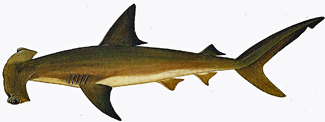 Hammerhead Shark
|
But you'd have to go some to beat the one caught off Florida in 2006 - over 14 feet long and weighing in at 1,262lbs. A huge fish, with a head 3 feet wide.
Hammerhead Sharks are unmistakable of course, with their laterally flattened head and their eyes located in the end-plates.
Six-Gilled Shark
|
A relative minnow by shark standards, the six-gilled shark is so named because - in a defiant gesture of one-upmanship - it has six gills along either side of its throat, rather than the standard shark set of five. |
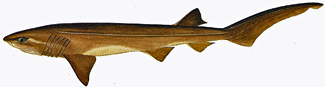 Six-Gilled Shark
|
This is a bottom feeding shark, and is mostly caught accidentally by anglers fishing for skate and rays.
The British rod-caught record for these types of sharks currently stands at 9lb 8oz for a specimen caught off Penlee Point, Plymouth.
Thresher Shark
|
Another easily identified shark, this one incorporating a design modification at the other end in the form of an impressive extension to the upper tail lobe. It's as long as the rest of the shark's torso, and is used to corral a shoal of mackerel or herring into an even tighter bunch. |
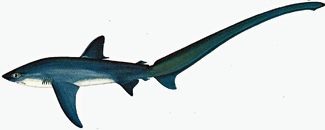 Thresher Shark
|
Having done so, the Thresher Shark gives the terrified fish a sharp 'thwack' with his tail, then leisurely proceeds to dine on the casualties. Clever.
Another large shark, approaching a maximum weight of 1,000lb or more.
The current British rod-caught record for Thresher Sharks weighed-in at 323lb was caught near the Nab Tower off Portsmouth.
All these types of sharks are in serious decline, and it can't be blamed on global warming. It's overfishing, both commercially and recreationally, so we anglers must all practice 'catch and release' if we're to help these wonderful creatures avoid extinction.
Recent Articles


-
Sea Fishing Rods and Reels Must Be Compatible for a Balanced Outfit
Mar 08, 21 08:30 AM
A quality reel fitted to a quality rod doesn't necessarily make it a quality outfit. Your fishing rods and reels have to be properly matched if you're to get the best out of them, and here’s how -
Essential Lure Fishing Tips That All Saltwater Anglers Should Know
Mar 08, 21 04:51 AM
Which single lure fishing tip applies to trolling, jigging, baitcasting, spinning, fly fishing and any other branch of lure fishing? Well, it is the one at the top of this list -
Vital Jig Fishing Tips That You Really Cannot Afford To Miss!
Mar 07, 21 10:20 AM
Essential jig fishing tips to help you select the right lure for successful jig fishing, together with the techniques required to get the most out of your jig fishing outfit

FTC Disclosure: In some of the articles on this site, I endorse some items of fishing gear. If you buy something through a link, I receive a small commission with no additional cost to you. Thank you for supporting this site. It is much appreciated.

New! Comments
Have your say about what you've just read! Leave me a comment in the box below.