- Home
- Fishing Gear
- Circle Hooks
Circle Hooks and the Drop-Back Trolling Technique
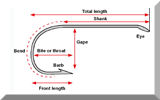
The main feature of circle hooks is their inward-angled point, which gives the impression that they're unlikely to hook-up with anything at all.
And that's partly the intention.
There's nothing worse than gut-hooking a fish.
Not only does it cause the fish a deal of unnecessary suffering, but you'll not be able to recover the hook without killing the fish.
But these hooks solve this problem.
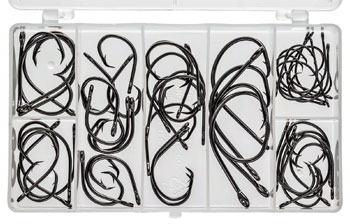
If a fish completely engulfs a bait, taking the hook into its stomach, any tension on the line will pull it back into the fish's mouth, the inward-facing point failing to catch on any internal part of the fish.
But when the direction of pull changes as the hook is drawn from the fish's mouth, the hook will secure a firm hold in the hinge of the jaw, from where it can be easily removed.
This makes these hooks the hooks of choice for 'Catch and Release' programmes - and ideal for use with the drop-back trolling technique.
Circle Hooks and the 'Drop-Back' Technique
Game fish, particularly billfish, often fail to cleanly grab a baitfish first time leaving it stunned and easy to grab the second time round. Billfish - sailfish, marlin, swordfish etc - are known to give a shoal of baitfish a healthy swipe with their bill, then picking off the stunned victims at leisure.
If your normally-rigged trolling bait - or lure - gets dealt this kind of treatment and continues swimming nonchalantly on, then it's likely to be considered non-standard behaviour by the predator and unworthy of further attention.
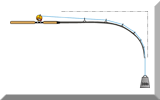
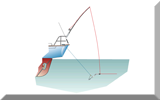
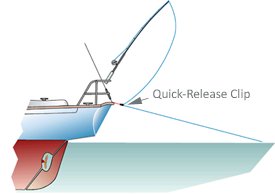 The drop-back technique requires the addition of a quick-release clip to your standard trolling set-up.
The drop-back rig changes all that. Slack is built into the line between the rod top and the bait by a strategically placed quick-release clip.
Now when the bait is 'stunned' it will be pulled from the QR clip and, for a few seconds, will stop. The likelihood now is that the predator will grab it - and you've got him!
In fact he may well have had time to engulf it completely, getting the hook caught well down his throat. This isn't ideal even if you intend to kill the fish for the table, and if you're a sport-fisherman heartily supporting the catch-and-release ethos, then it's very bad news indeed for both the fish and the angler.
And even for the offshore sailor fishing to feed his crew, perhaps the fish is too big. No more room in the fridge? You won't want to kill this handsome creature unnecessarily. And if you've nose-rigged your lure with a circle hook you probably won't have to.
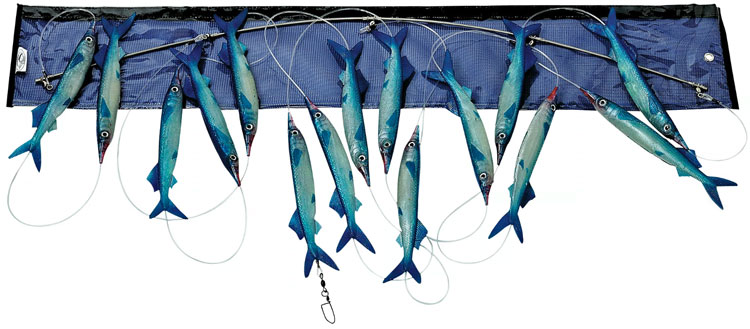
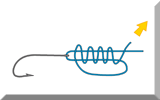
The 'lure' used in a drop-back rig will normally be a nose-rigged natural bait, usually a ballyhoo.
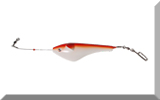
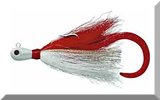
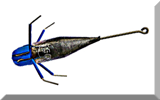
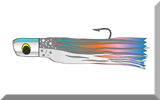
However at least one artificial lure can be adapted for nose-rigging with a circle hook for the drop-back method - the Williamson Lures Live Ballyhoo shown here.
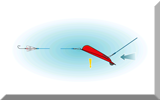
It's clear from the illustration that an early strike when using a nose-rigged bait isn't a good idea.
The fish must be given ample time to swallow the bait before the angler tightens up on the line, allowing this special hook to do its job.
Recent Articles


-
Sea Fishing Rods and Reels Must Be Compatible for a Balanced Outfit
Mar 08, 21 08:30 AM
A quality reel fitted to a quality rod doesn't necessarily make it a quality outfit. Your fishing rods and reels have to be properly matched if you're to get the best out of them, and here’s how -
Essential Lure Fishing Tips That All Saltwater Anglers Should Know
Mar 08, 21 04:51 AM
Which single lure fishing tip applies to trolling, jigging, baitcasting, spinning, fly fishing and any other branch of lure fishing? Well, it is the one at the top of this list -
Vital Jig Fishing Tips That You Really Cannot Afford To Miss!
Mar 07, 21 10:20 AM
Essential jig fishing tips to help you select the right lure for successful jig fishing, together with the techniques required to get the most out of your jig fishing outfit

FTC Disclosure: In some of the articles on this site, I endorse some items of fishing gear. If you buy something through a link, I receive a small commission with no additional cost to you. Thank you for supporting this site. It is much appreciated.




New! Comments
Have your say about what you've just read! Leave me a comment in the box below.