Two Proven Methods of
Fish Hook Removal
You really need to know about fish hook removal, as it's very easy to get a hook embedded in your finger, even if there's no fish involved.
But if it's deeply embedded, you're unlikely to be able to remove it on your own - you'll need help. So these methods are for removing a hook either from someone else's flesh, or having them get one out of yours.
If it's the latter, be brave ...
The risk of needing either of these fish hook removal methods is much reduced by protecting the hook points whenever it's practical ...
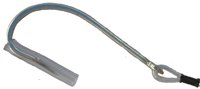
- Use corks or polystyrene foam for single and double hooks, and proprietary plastic protectors for small treble hooks.
- Alternatively a short piece of plastic tube can be pushed over the point and barb.
If, despite these precautions, you or a fellow angler is unlucky enough to get impaled on a hook, one of the following fish hook removal methods will get it out:~
The 'Push and Cut' Method of Fish Hook Removal
First, clean around the point of entry with antiseptic ointment. If the hook has gone in in such a way that the point is close to the skin, you should consider the 'push and cut' method:~
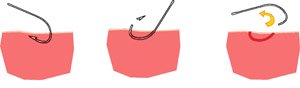
- Push the hook through so that the point and the barb exit the skin
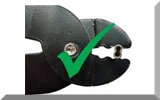
- Cut off the point below the barb with a pair of pliers
- Withdraw the hook in the direction from whence it came
The 'Snatch Method' of Fish Hook Removal
A disadvantage of the 'Push and Cut' method is that it's quite painful and creates a further wound. A less painful alternative, and the one to use where the hook point has not gone in so far is the 'snatch method':~
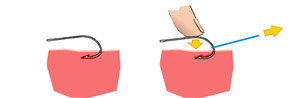
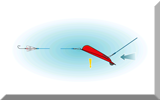
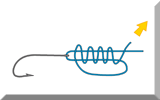
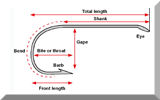
- Loop a length of line of not less than 20lb breaking strain around the bend of the hook.
- Get a firm grip on the line, by wrapping it around your hand
- With your other hand, press the eye of the hook down towards the surface of the skin and back toward the hook's bend, as if trying to back the hook out along the path of entry. This will disengage the barb from the flesh, and align the embedded part for removal
- While pressing on the hook eye, give the line a short, sharp pull parallel to the skin and in line with the hook, to snap the hook back out of the wound.
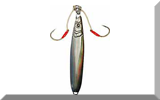
Be particularly careful when removing a multi-hooked lure
I met a French sailboat skipper in Martinique who, while attempting to remove a treble hook from the hand of his crewmate, managed to impale his own finger on a second treble on the same lure. Being in mid-Atlantic at the time, the prospect of sharing each other's intimate moments for 1,500 miles was a depressing prospect.
Next time, he told me, he would either remove, cut off the points, or tape up all other hooks before attempting first aid. Good thinking!
Whichever method you use, always wash the wound thoroughly, apply antiseptic ointment and a simple dressing.
Check that your tetanus shots are up to date, and if not, attend to it at the earliest opportunity.
And one final piece of advice ...
Always wear some form of eye protection - spectacles or sunglasses at least - when using the snatch method. A hook in your eye would be seriously bad news...
Recent Articles


-
Sea Fishing Rods and Reels Must Be Compatible for a Balanced Outfit
Mar 08, 21 08:30 AM
A quality reel fitted to a quality rod doesn't necessarily make it a quality outfit. Your fishing rods and reels have to be properly matched if you're to get the best out of them, and here’s how -
Essential Lure Fishing Tips That All Saltwater Anglers Should Know
Mar 08, 21 04:51 AM
Which single lure fishing tip applies to trolling, jigging, baitcasting, spinning, fly fishing and any other branch of lure fishing? Well, it is the one at the top of this list -
Vital Jig Fishing Tips That You Really Cannot Afford To Miss!
Mar 07, 21 10:20 AM
Essential jig fishing tips to help you select the right lure for successful jig fishing, together with the techniques required to get the most out of your jig fishing outfit

FTC Disclosure: In some of the articles on this site, I endorse some items of fishing gear. If you buy something through a link, I receive a small commission with no additional cost to you. Thank you for supporting this site. It is much appreciated.

New! Comments
Have your say about what you've just read! Leave me a comment in the box below.