- Home
- Artificial Lures
- Bucktail Jigs
Bucktail Jigs: Are these the Most Versatile Lures in your Tacklebox?
I'm a real fan of bucktail jigs. Jig them vertically in deep water, work them over the bottom in shallow water from a slowly drifting boat, cast and retrieve them or even - at a pinch - troll them astern. With just these lures in your tackle box, you've got options and alternatives.
But unlike other lures, bucktail jigs have got no built-in action.
Movement throughout the water isn't enough to make them wriggle and dart about, sending out sonic and visual signals.
OK, trolled astern at constant speed and direction, they will catch fish, but they'll catch more if they're given some action by the angler.
Bucktails are at their best when worked on or close to the sea bed, either from a drifting boat or at the hands of a skilful angler casting from the shore.
Fishing with Bucktail Jigs from a Drifting Boat
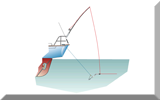
One of my favourite ways to fish is drifting in Alacazam's (my sailboat) inflatable dinghy, using a bucktail jig and a light spinning outfit.
Following an upwind cast, the technique is to 'bounce' the lure along the bottom, using a flick of the wrist. If you use braid line you'll find that you'll be able to 'feel' every twitch of the lure and gentle pluck of an interested fish.
Between bounces, use a twitching action, and every so often, lift the rod so that the bucktail rises well clear of the sea bed, then lower it slowly so that you remain in touch with the lure at all times.
Be ready to strike at any time - if it feels like you've snagged the bottom, assume it's a fish until you know one way or the other.
Favourite times for jig fishing are dawn and dusk, which coincides nicely with breakfast and supper time!
Fishing with Bucktails from an Anchored Boat
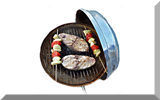
 I think that one can go back Mary...
At anchor, and with a current running through the anchorage, I (or Mary) fish from Alacazam's decks rather than from the inflatable. As you can see here, results are sometimes less than spectacular...
Using the same light spinning outfit, I cast across the tide, then use the bounce/twitch/lift technique until the lure is astern.
I then start to wind in slowly, bouncing, twitching and lifting until contact with the bottom is lost. Then start the process again.
The same technique can be used when casting from the shore.
But afloat or ashore, I always use the smallest, lightest bucktail jig that I can get away with.
As long as you can feel the bump as the lure bounces on the bottom, it's big enough.
Any big fish will take a small lure, but a small one is likely to shy away from a large one - and a pansize fish will do very nicely for breakfast or supper.
For this degree of sensitivity you'll need to fish the bucktail without any additional weight on the line. But do tie in a swivel about 3 feet (1m) ahead of the bucktail to deal with any line twists that develop.
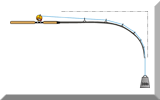
If you keep getting hung up on the bottom, you could tie in a 3-way swivel some 5 feet (1.5m) ahead of the lure and rig a pear lead on a one foot long (300mm) rotten bottom. This will help keep the lure off the bottom, but you'll lose a lot of the sensitivity.
Top-Rated Bucktail Jigs
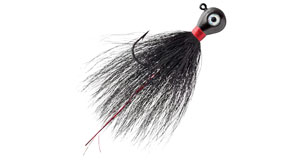
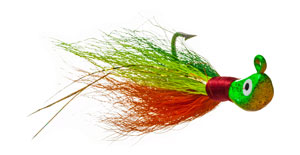
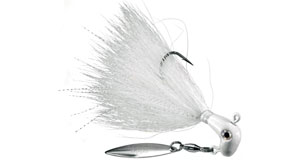
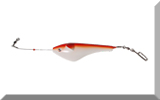
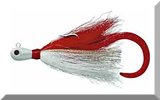
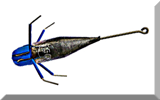
Some bucktails - like the TTI-Blakemore Bucktail Pro Runner offered here - sport a small spinner, adding an attracting flash that they would otherwise lack.
A small sliver of squid or mackerel provides the additional attraction of scent - which is never a bad thing.
However, there are so many alternatives out there, it's a mistake to get hung up on one particular lure.
Recent Articles


-
Sea Fishing Rods and Reels Must Be Compatible for a Balanced Outfit
Mar 08, 21 08:30 AM
A quality reel fitted to a quality rod doesn't necessarily make it a quality outfit. Your fishing rods and reels have to be properly matched if you're to get the best out of them, and here’s how -
Essential Lure Fishing Tips That All Saltwater Anglers Should Know
Mar 08, 21 04:51 AM
Which single lure fishing tip applies to trolling, jigging, baitcasting, spinning, fly fishing and any other branch of lure fishing? Well, it is the one at the top of this list -
Vital Jig Fishing Tips That You Really Cannot Afford To Miss!
Mar 07, 21 10:20 AM
Essential jig fishing tips to help you select the right lure for successful jig fishing, together with the techniques required to get the most out of your jig fishing outfit

FTC Disclosure: In some of the articles on this site, I endorse some items of fishing gear. If you buy something through a link, I receive a small commission with no additional cost to you. Thank you for supporting this site. It is much appreciated.

New! Comments
Have your say about what you've just read! Leave me a comment in the box below.