- Home
- Fishing Rigs
- Rigging Trolling Lures
Rigging Trolling Lures
for Saltwater Fishing
Rigging trolling lures like plugs and spoons for maximum security is fairly
straightforward; your main consideration will be limited to the length
and material for the leader together with your own expertise in making the lure connection at one end and a reinforced loop at the other.
From all other aspects, you're pretty much stuck with the workmanship of the lure manufacturer.
This is particularly true with plugs, where some of the lesser-known manufacturers from distant shores may not be quite as diligent as more familiar lure companies like Rapala, Yo-Zuri, Williamson and so on.
But skirted trolling lures are a different matter, as they're made up of individual components that can be customised to suit the precise requirements of the angler.
Unlike all other trolling lures - except the cedar plugs and their derivatives - the ultimate strength of the skirted trolling lure is entirely up to the angler rigging it.
The skirt and the lure head don't take any of the load - it's all down to the hook and the leader and the connection between the two. It's no wonder that skirted trolling lures are so popular with big-game fishermen.
But how do you go about rigging trolling lures of this type? A good place to start would be the hook.
Hook Choice for Rigging Trolling Lures
My first venture into the world of offshore trolling was through trailing a plastic squid lure astern of my sailboat. It was only after losing fish after poorly-hooked fish, and having the hook straightened out a few times did I come to the conclusion that all was not as it should be.
Now I only use hooks that are truly up to the job and I keep them razor sharp.
And they're definitely not as sharp as they could be when they come out of the packet, so you'll need to do some work on them with a hook file before using them for the first time, and check them after every fish.
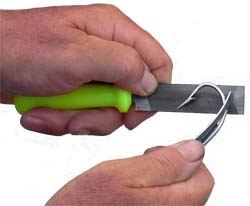
How to check them? Just run the point lightly over your thumbnail - if it tends to catch or dig in, it's sharp.
If it just skates over the surface, it isn't.
So far so good - right hook, properly sharpened, but what about size?
The Correct Size Hook for the Chosen Lure
 Make sure the hook is the right size for the lure...
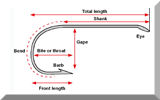
I can't remember who showed be this trick - but it works. Just check the hook against the head of the lure. If the gape of the hook is pretty much the same as the diameter of the head, then the hook size is about right.
Just one more thing, the location of the hook within the lure...
Positioning the Hook Within the Lure
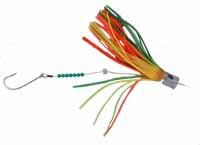 and is in the right place...
You don't want the hook hanging out the back of the lure where it might spook the fish, nor do you want it too far forward where it might not gain a secure hold in the fish's mouth. It needs to be close to the back of the skirt, but still concealed within it.
The precise location can be fine-tuned by incorporating plastic beads between the hook and the lure head as shown in the pic.
Next, the Leader
The most popular leader for trolling lures is heavy nylon monofilament line, and rightly so for most applications.
Recently though, having convinced myself that it really makes a difference, I've been gradually swapping these as they become due for replacement, with fluorocarbon line.
Two things to know about fluorocarbon leaders - one is that this stuff is almost invisible under water, and two it's mighty expensive. Much more so than mono, and especially in the high breaking strains that you'll need for offshore trolling. So before you click on this link, take a deep breath...
Neither of these will stand up to the treatment handed out by predators with a well-developed set of dentures, like wahoo for example. For these you'll need a wire leader.
Think carefully before going down the single-strand wire route though, as it can work-harden and fail when you'd much rather it didn't. This is particularly true when using a trolling lure with a good swimming action. Think of how you snap off the end when tying a haywire twist and you'll see what I mean!
Plastic covered multi-strand wire is a good choice for the toothy chaps, but watch out for nicks and scratches in the coating. Once water gets trapped between the wire and the coating it will quickly corrode - with predictable results.
For the ultimate in durability plain wire cable is the way to go. Nothing, but nothing, will chew through this. But it's equally as visible to the fish as is the lure, which is not good news...
Read more about choosing the best type of wire for trolling leaders...
Making Connections:~
Hook to Leader and Leader to Main Line
Unless you're using a mono or fluorocarbon leader of less than 50lb breaking strain, connecting the leader to the hook with a knot isn't going to work.
More expense - you'll need a crimping kit for rigging trolling lures with anything other than single-strand wire.
If you haven't already got it, you're going to need a crimping tool and a selection of suitable sleeves.
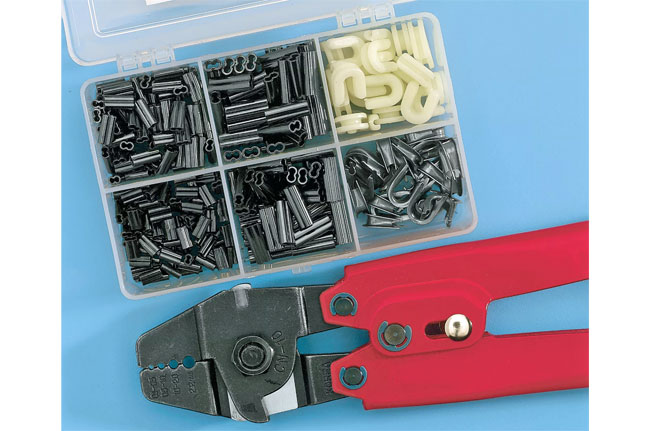
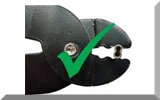
Clearly, the rig must be properly made up, so here are some key tips on using your crimping kit for rigging trolling lures. Follow these and you'll be an expert in no time!
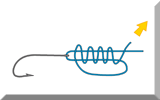
Crimps though, won't hold in single strand wire - the wire will pull straight through when any load is applied to it. The only way of making a connection in this stuff is with a Haywire Twist.
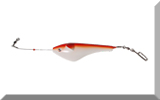
At the other end of the leader make a reinforced crimped loop, either with a Flemish Eye or a thimble. The kit shown here contains both stainless steel and plastic ones.
Recent Articles


-
Sea Fishing Rods and Reels Must Be Compatible for a Balanced Outfit
Mar 08, 21 08:30 AM
A quality reel fitted to a quality rod doesn't necessarily make it a quality outfit. Your fishing rods and reels have to be properly matched if you're to get the best out of them, and here’s how -
Essential Lure Fishing Tips That All Saltwater Anglers Should Know
Mar 08, 21 04:51 AM
Which single lure fishing tip applies to trolling, jigging, baitcasting, spinning, fly fishing and any other branch of lure fishing? Well, it is the one at the top of this list -
Vital Jig Fishing Tips That You Really Cannot Afford To Miss!
Mar 07, 21 10:20 AM
Essential jig fishing tips to help you select the right lure for successful jig fishing, together with the techniques required to get the most out of your jig fishing outfit

FTC Disclosure: In some of the articles on this site, I endorse some items of fishing gear. If you buy something through a link, I receive a small commission with no additional cost to you. Thank you for supporting this site. It is much appreciated.



New! Comments
Have your say about what you've just read! Leave me a comment in the box below.