- Home
- All About Reels
- Cheap Fishing Reels
Don't be Let Down by
Really Cheap Fishing Reels
It's almost inevitable that really cheap fishing reels won't stand up to the rigours of saltwater fishing. They are let down by the use of low quality materials that soon fall prey to corrosion, and poor manufacturing techniques that will lead to mechanical failure - a sure recipe for early disappointment. But it doesn't have to be so...
Even with a limited budget - as most of us are these days - you can get good quality fishing reels that won't break the bank.
And anyway, why pay more than you have to?
With many of the major reel manufacturers currently outsourcing production to China and the Far East - even Penn Reels are now made in China, and Okuma Reels have manufacturing plants in both Taiwan and China - perhaps we should take a look at other brands of fishing reels made in these far-off lands.
Are Cheap Fishing Reels Poor Value?
We naturally equate low price with low quality, but this assumption can be far from true. With modern design and manufacturing techniques imported from the west - coupled with a skilled, motivated and cheap labour source - countries such as China can now produce Cheap Fishing Reels under their own brand names that are getting to match the quality of those once made in the US and Western Europe.
And when they get it right, it can represent very good value indeed.
Best Value Casting Reels
Let's say you want a reel for casting and you only have a certain amount of cash to spend. What should you spend it on, a baitcaster or a spinning reel? Well...
Unlike spinning reels, where no mechanical parts are moving during the cast, there's plenty going on mechanically in a baitcast reel - the spool is rotating at high speed, the line level-wind system is moving back and forth across the reel cage, and the braking system is trying to keep everything under control.
All of this complexity demands a level of engineering quality that is difficult to achieve at very low cost.
So if you want a reel primarily for casting and you need to keep your expenditure to a minimum, my advice would be to go for a spinning reel rather than a baitcaster reel.
Cheap Spinning Reels
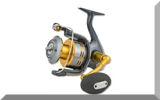
The one above looks interesting, a very good spec for the price and it comes with a 12 month warranty.
Take note too of the number of ball bearings. Generally, the more the better as these will influence the smoothness of the winding motion.
The '+1 Ball Bearing' refers to the bale-arm roller. It's most important that the reel has a ball bearing rather than a plain bush here, or line twists and rapid wear are sure to occur.
Take a look at the pic of the reel and check the position of the drag adjustment. If it's mounted at the back of the reel it won't be powerful enough for saltwater use. Choose one with a front-mounted drag adjustment, where it operates directly on the spool.
More Cheap Fishing Reels...
A multiplier (or baitcaster) reel this time
This one is worth a look. A great specification and very inexpensive for a reel of this type
and finally...
I've not had the opportunity to even hold one of these reels yet, never mind use one, so I can't say that they're definitely the bargain they appear to be.
But buying through Amazon gives a good level of protection if they turn out to be less than satisfactory.
Recent Articles


-
Sea Fishing Rods and Reels Must Be Compatible for a Balanced Outfit
Mar 08, 21 08:30 AM
A quality reel fitted to a quality rod doesn't necessarily make it a quality outfit. Your fishing rods and reels have to be properly matched if you're to get the best out of them, and here’s how -
Essential Lure Fishing Tips That All Saltwater Anglers Should Know
Mar 08, 21 04:51 AM
Which single lure fishing tip applies to trolling, jigging, baitcasting, spinning, fly fishing and any other branch of lure fishing? Well, it is the one at the top of this list -
Vital Jig Fishing Tips That You Really Cannot Afford To Miss!
Mar 07, 21 10:20 AM
Essential jig fishing tips to help you select the right lure for successful jig fishing, together with the techniques required to get the most out of your jig fishing outfit

FTC Disclosure: In some of the articles on this site, I endorse some items of fishing gear. If you buy something through a link, I receive a small commission with no additional cost to you. Thank you for supporting this site. It is much appreciated.



New! Comments
Have your say about what you've just read! Leave me a comment in the box below.